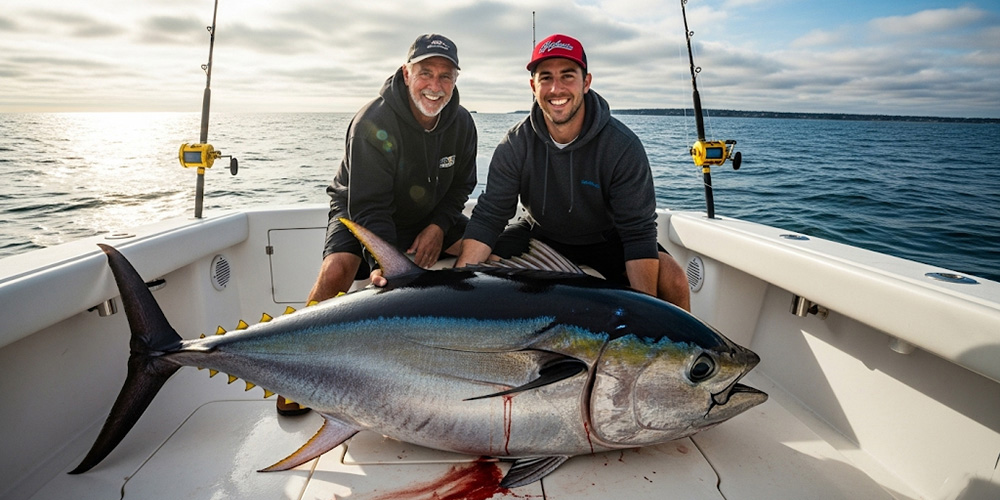
From the bustling sushi markets of Tokyo to the time-honored nets of the Mediterranean, tuna have shaped human culture, cuisine, and economies for centuries. These mighty ocean wanderers captivate anglers, fuel multimillion-dollar auctions, and sustain communities worldwide. While some tuna populations thrive, others face overfishing, spurring global conservation efforts to ensure their future. Explore the vibrant history, rich traditions, and critical measures that define tuna's enduring legacy.
Article Contents
- Japan's Tuna Obsession
- Mediterranean Traditions
- As a Gamefish and Table Fare in America
- Tuna In World Cuisine
- A Multibillion-Dollar Industry
- Fishing Lore and Traditions
- Overfishing and Conservation Efforts
- Fishing Regulations
- Highly Migratory Species Management
- Species-Specific Rules
- Bluefin Tuna Restrictions
- Bycatch Avoidance
- Florida's Blackfin Tuna Limits
- California's Pacific Bluefin Rules
- Other Pacific Tuna Limits
- Gulf Coast States
- International Regulations (ICCAT and Others)
- Atlantic Tuna Management
- Recovery of Atlantic Bluefin
- Pacific Tuna Management
- Challenges and Consumer Role
- Catch and Release and Ethical Practices
- Conclusion
- Tuna Culture, History, and Conservation FAQs
- Shop the Gear
- We're Here to Help!
- Related Articles
Japan's Tuna Obsession
Tuna's culinary significance is perhaps most pronounced in Japan, where fresh bluefin tuna is the centerpiece of high-end sushi and sashimi. Japanese fleets and markets drive a large portion of the world's tuna trade, and record-breaking tuna auctions in Tokyo, illustrate the almost mythical status of bluefin in Japanese culture. Tuna (maguro) appears in everything from everyday dishes like tuna bowls and sashimi to luxurious celebrations of the fattest otoro cuts.
Mediterranean Traditions
In the Mediterranean, tuna have been caught and enjoyed since ancient times—Phoenician and Roman writings describe elaborate tuna traps. A traditional method called almadraba (in Spain and Morocco) or tonnara (in Italy) uses a maze of nets to corral migrating Atlantic bluefin tuna, a practice that dates back centuries and is still used in a few regions. Mediterranean cuisines serve tuna grilled, cured, or preserved in olive oil, and cities like Carloforte in Italy have annual tuna festivals.
As a Gamefish and Table Fare in America
In the United States, tuna is both a staple food and a sportfishing icon. Canned tuna (often albacore or skipjack) became an American pantry staple in the 20th century, leading to creations like the classic tuna salad and tuna casserole. At the same time, big-game tuna fishing caught public imagination—writers like Zane Grey and Ernest Hemingway wrote about pursuing giant tuna, and today TV shows like Wicked Tuna depict the thrill (and challenges) of chasing bluefin off the New England coast.
Tuna In World Cuisine
From Hawaiian poke (which often features yellowfin or bigeye tuna) to French salade niçoise (traditionally using tuna) to Mexican atun tacos, tuna features in a stunning variety of regional dishes worldwide.
A Multibillion-Dollar Industry
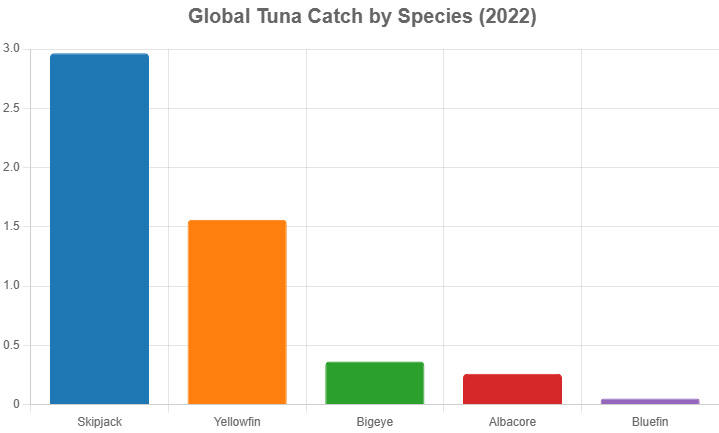 Global Tuna Catch (2022, In million tonnes) Source: ISSF Status of the Stocks report for 2022
Tuna fisheries are among the most valuable in the world. The global tuna industry is a multibillion-dollar enterprise, employing thousands of people in fishing, processing, and trading. Skipjack and yellowfin tunas form the backbone of the canned tuna market, providing affordable protein worldwide—skipjack alone contributed nearly 2.8 million tonnes to the annual catch in 2012.
High-End Bluefin Market
On the other end of the spectrum, a single top-grade bluefin tuna can sell for hundreds of thousands of dollars (especially in Japanese auctions), reflecting its value in high-end sushi markets. This demand for tuna has driven innovation in fishing methods (from pole-and-line and purse seines to longlines) and also led to overfishing concerns.
Economic Impact on Communities
Economically, tuna fishing can be a boom for coastal communities: places like Gloucester, Massachusetts, or San Diego, California, have long histories as tuna hubs. Tuna canneries once flourished in locales such as California's Channel Islands and American Samoa. Today, consumers are increasingly encouraged to choose tuna from sustainable sources (like pole-and-line caught skipjack or tuna certified by organizations like the MSC) to ensure these fish remain plentiful for future generations.
Fishing Lore and Traditions
Throughout history, tuna have inspired respect and sometimes awe among those who pursue them. Ancient Greeks depicted tunny (likely bluefin) in their art and coins. Pacific Islander cultures, such as in Polynesia, have traditional tuna fishing techniques and consider tunas like skipjack (aku in Hawaiian) important for sustenance and ceremony.
Hawaiian Ahi Fishing
In Hawaii, yellowfin tuna are called ahi and are a cherished resource, caught by methods ranging from modern charter boats to traditional ikon (trolling with feather jigs behind outrigger canoes).
Atlantic "Monster Tuna" Tales
In the Atlantic, the giant bluefin runs along Nova Scotia's coast in the mid-1900s gave rise to "Monster Tuna" tales—rod-and-reel catches of bluefin over 600 kg (1,300 lbs) were made by pioneering anglers, contributing to scientific understanding and the allure of catching "the big one."
Modern Tournaments and Art
Tuna tournaments now take place in many regions (for example, the Bisbee's Tuna Tournament in Cabo San Lucas or the Offshore World Championship), where anglers compete to land the heaviest tuna. Culturally, the image of the tunny fisherman, standing sturdy on a rocking boat fighting an unseen giant beneath the waves, has become emblematic of deep-sea angling itself. From folklore to fine art (even Salvador Dalí featured tunas in a painting), tuna have secured a place both as nourishment and inspiration in human society.
Overfishing and Conservation Efforts
By the late 20th century, some tuna stocks, particularly the northern and southern bluefin, were severely overfished to supply growing sushi demand. In response, international management bodies and conservation groups have worked to curb catches and allow stocks to rebuild—with some success in recent years for Atlantic bluefin.
Fishing Regulations
Because of tuna's importance and heavy fishing pressure, they are subject to extensive regulations to manage stocks sustainably. Rules vary by species, region, and whether fishing is commercial or recreational. Anglers should always check the latest regulations before targeting tuna.
Highly Migratory Species Management
In U.S. Atlantic and Gulf of Mexico waters, tunas are managed as Highly Migratory Species (HMS) by NOAA. Recreational fishermen must have an HMS Angling permit and follow species-specific size and bag limits.
Species-Specific Rules
For example, yellowfin tuna must be at least 27 inches curved fork length to keep, with a bag limit of 3 yellowfin per person per day. Bigeye tuna (another large species) also have a 27-inch minimum size, but no explicit per-person bag limit (though they are less commonly caught recreationally). Albacore and skipjack tuna have no minimum size and no bag limits in U.S. Atlantic waters—they are generally abundant and not considered overfished.
Bluefin Tuna Restrictions
Bluefin tuna, however, have the strictest rules: NOAA sets seasonal quotas and size classes (school, large school, etc.) for Atlantic bluefin each year, often allowing only one (or a few) bluefin per vessel per day when the season is open. Bluefin under a certain size must usually be released, and any landed bluefin (even by recreational anglers) must be reported to NOAA within 24 hours. These measures are in place to prevent over-harvest of bluefin and ensure compliance with international quotas.
Bycatch Avoidance
Note: if you have a shark like an oceanic whitetip on board, you cannot keep any tunas on that trip (a bycatch avoidance rule).
Florida's Blackfin Tuna Limits
Individual U.S. states may have additional rules, especially for tunas in state waters. In Florida, where tuna fishing (primarily for smaller species like blackfin tuna) is popular, the state recently implemented a bag limit for blackfin tuna of 2 fish per person or 10 per vessel per day (whichever is greater). This applies in Florida state waters (within 9 miles Gulf coast / 3 miles Atlantic coast) to preserve local blackfin stocks. Florida requires harvested billfish and tuna to be reported to NOAA and enforces HMS permit requirements in federal waters.
California's Pacific Bluefin Rules
In California (Pacific coast), tuna are managed in coordination with federal rules. For instance, the recreational catch of Pacific bluefin tuna off California is limited to 2 bluefin per person per day, with a total possession limit of 6 on multi-day trips. This was reduced from an older 10-fish limit to align with international efforts (via the Inter-American Tropical Tuna Commission, IATTC) to rebuild Pacific bluefin stocks.
Other Pacific Tuna Limits
Other tunas like yellowfin or skipjack in California waters have a 10-fish daily bag limit (within the overall 20-fish general finfish limit) per state regulations—effectively liberal, since typical catches rarely hit that number. Always check the latest California Department of Fish and Wildlife rules, as they update seasons and limits (especially if tuna are landed from Mexican waters, which have their own limits).
Gulf Coast States
In the Gulf Coast states, regulations mirror federal HMS rules for species like yellowfin, and some states (like Texas, Louisiana) also set guidelines for blackfin tuna similar to Florida's.
International Regulations (ICCAT and Others)
Tuna are highly migratory, often crossing international boundaries, so management requires global cooperation.
Atlantic Tuna Management
The International Commission for the Conservation of Atlantic Tunas (ICCAT) is the body governing tuna fisheries in the Atlantic Ocean (including the Mediterranean). ICCAT sets quotas for commercial catch of species like Atlantic bluefin, bigeye, and yellowfin tuna, and coordinates research and conservation measures among member countries.
Recovery of Atlantic Bluefin
Thanks to ICCAT-enforced quotas and protections (like restricted fishing seasons and no-fishing zones during spawning), Atlantic bluefin tuna stocks have shown signs of recovery from their early-2000s lows. For example, ICCAT's strict quota system curtailed massive overfishing that was occurring (sometimes illegally) in the Eastern Atlantic and Mediterranean. ICCAT also mandates measures like minimum size limits and monitoring of tuna farming (ranching of captured juvenile bluefin).
Pacific Tuna Management
In the Pacific, the IATTC and the Western & Central Pacific Fisheries Commission (WCPFC) perform similar roles for managing Pacific tunas (yellowfin, bigeye, skipjack, Pacific bluefin). These organizations have implemented seasonal closures (e.g., "FAD bans" to reduce juvenile catch), vessel quotas, and required use of non-entangling FADs, among other measures.
Challenges and Consumer Role
Sustainability is a major concern in tuna fisheries—some stocks like Southern bluefin tuna remain at very low levels, and illegal overfishing has in the past taken nearly double the agreed quotas. Consumers can help by choosing tuna caught with sustainable methods (e.g., pole-and-line, troll, handline) and from well-managed fisheries. Many grocery stores now label canned tuna with its catch method and origin.
Catch and Release and Ethical Practices
For sport anglers targeting large or threatened tuna (e.g., bluefin or bigeye), adopting catch-and-release or selective harvest is encouraged. Releasing big breeding-size fish can help sustain the population. When releasing a tuna, do so quickly and handle the fish minimally—use a dehooker or cut the line close if needed, and ensure the fish is revived in the water before letting go.
Some fisheries require the use of circle hooks when using natural bait for tuna, to reduce deep-hooking and bycatch of species like billfish or sharks. It's also good practice to log your tuna catches (length, weight, location) and report tags if you recapture a tagged tuna, as this data contributes to research.
By staying informed on regulations—from federal HMS rules to local limits—and practicing ethical fishing, we can continue to enjoy fantastic tuna fishing while conserving these ocean treasures for future generations.
Conclusion
Tuna, with their global culinary allure and storied fishing legacy, remain a vital thread in the fabric of human culture and economies. From ancient traditions to modern conservation efforts, these remarkable fish inspire both reverence and responsibility. By embracing sustainable practices and informed choices, we can ensure that tuna continue to thrive in our oceans and on our plates for generations to come.
Tuna Culture, History, and Conservation FAQs
What makes tuna a cultural icon in Japan?
Tuna, particularly bluefin, is revered in Japanese cuisine for its rich flavor, forming the backbone of sushi and sashimi dishes. Its prominence in meals from everyday tuna bowls to high-end otoro cuts underscores its deep cultural significance.
What are traditional tuna fishing methods in the Mediterranean?
The Mediterranean uses ancient techniques like almadraba (Spain, Morocco) and tonnara (Italy), where nets corral migrating Atlantic bluefin tuna. These methods, dating back centuries, are still practiced in some regions.
How did canned tuna become a staple in the United States?
In the 20th century, affordable skipjack and albacore tuna were canned, becoming a pantry staple. This led to popular dishes like tuna salad and tuna casserole, cementing tuna's place in American diets.
What is the economic value of the global tuna industry?
The tuna industry is worth billions, employing thousands in fishing, processing, and trading. Skipjack and yellowfin drive the canned market, while bluefin supports high-end markets.
Are all tuna species overfished?
No, not all tuna are overfished. Species like skipjack and albacore are generally abundant, but bluefin and some bigeye stocks have faced overfishing, prompting conservation measures.
What role does tuna play in Pacific Islander cultures?
In Polynesian cultures, tuna like skipjack (aku in Hawaiian) are vital for sustenance and ceremonies. Traditional fishing methods, such as trolling with feather jigs in Hawaii, reflect their cultural importance.
How has Ernest Hemingway contributed to tuna fishing lore?
Hemingway wrote about chasing giant tuna in his 1936 Esquire article "On the Blue Water," describing Gulf Stream fishing. His experiences, including landing a 381-pound tuna in 1935, inspired The Old Man and the Sea.
What are the key U.S. regulations for recreational tuna fishing?
In U.S. Atlantic and Gulf waters, recreational anglers need an HMS Angling permit. Rules include size limits (e.g., 27 inches for yellowfin), bag limits (e.g., 3 yellowfin per person daily), and strict quotas for bluefin, which must be reported to NOAA.
How does the International Commission for the Conservation of Atlantic Tunas (ICCAT) help tuna stocks?
ICCAT sets commercial catch quotas, enforces size limits, and restricts fishing during spawning seasons. These measures have aided the recovery of Atlantic bluefin stocks since their early-2000s lows.
What are sustainable tuna fishing methods?
Sustainable methods include pole-and-line, troll, and handline fishing, which reduce bycatch. Consumers can choose tuna certified by organizations like the MSC to support well-managed fisheries.
Why is catch-and-release encouraged for some tuna species?
Catch-and-release, especially for large bluefin or bigeye, helps sustain breeding populations. Quick releases with minimal handling (e.g., using dehookers) ensure fish survive, supporting conservation.
How can consumers support tuna conservation?
Consumers can buy tuna from sustainable sources, like pole-and-line caught skipjack, and check labels for catch method and origin. Supporting science-based management and reporting tagged tuna also aids research.
Shop the Gear
- Shop all Rod & Reel Combos
- Shop all Fishing Rods
- Shop all Fishing Reels
- Shop all Terminal Tackle
- Shop all Fishing Lures and Baits
- Shop all Fishing Line and Leaders
- Shop all Fishing Hooks
- Shop all Fishing Gaffs
- Shop all Outriggers and Rigging Kits
- Shop all Fighting Belts
We're Here to Help!
Whether you're casting lines, exploring coastal waters, or embracing sustainable practices on the open sea, West Marine is your partner for every boating adventure. Our expert resources and high-quality gear are ready to support your journey, from fishing to cruising and beyond. Visit us online or at a West Marine store to find everything you need for life on the water. Click our store locator to discover the nearest West Marine and start your next adventure today!