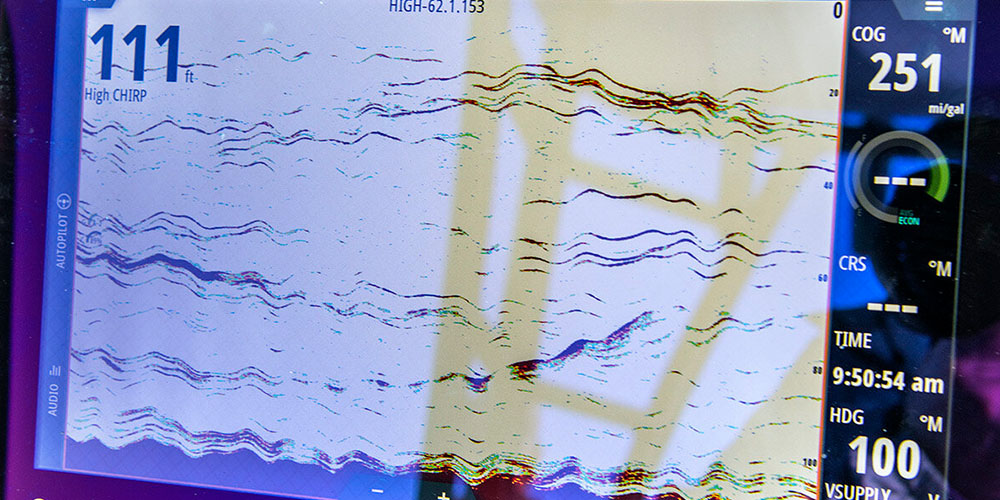
If you've looked at a modern fishfinder and wondered what CHIRP means — and whether it's worth paying more for — this article answers both questions. CHIRP sonar delivers significantly better target separation, depth performance, and image clarity than traditional single-frequency sonar. Here's how it works and how to choose the right frequency for how and where you fish. We'll help you to understand CHIRP, and what investing in a compatible fishfinder can do to improve your fishing and boating.
- Traditional Fixed-frequency Sonar
- CHIRP Sonar with Ascending Frequency Range
- Pulse Compression and Pattern Correlation
- CHIRP Frequencies
- The Arrival of “Cheap CHIRP”
- Glossary of Terms
- FAQ
Traditional Fixed-frequency Sonar
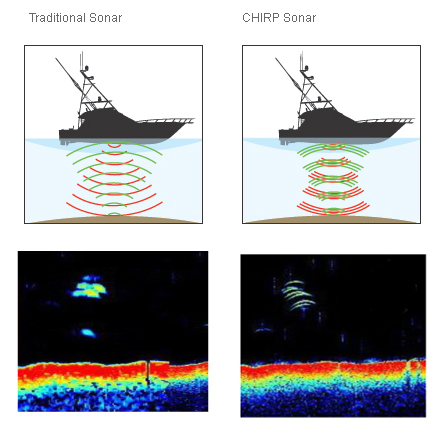
CHIRP sonar resolves images better than the traditional sonar we’ve been using for decades.
Traditional sonar transmits a powerful ping, or pulse of energy into the water column at a specific frequency, then “listens” for the echoes to return. The unit’s software then processes this information to create the image of the bottom, structure and fish that you see on the display’s screen. This type of “tone burst” energy pulse may be high in power, but it is very short in duration. This limits the total amount of energy that can be transmitted into the water column.
Different frequencies reveal different levels of detail. For example, a high-frequency 200kHz pulse provides excellent detail, but can’t penetrate very deeply into the water. A low-frequency 50kHz pulse penetrates deeper but reveals less detail. This is why most traditional sonars now use at least a dual-frequency or even triple-frequency transducer to provide a good combination of depth and detail.
CHIRP Sonar with Ascending Frequency Range
CHIRP (an acronym for Compressed High-Intensity Radiated Pulse) is a game-changing technology that has been used by the military for decades in both radar and sonar. CHIRP technology began filtering down to recreational sonars in about 2009.
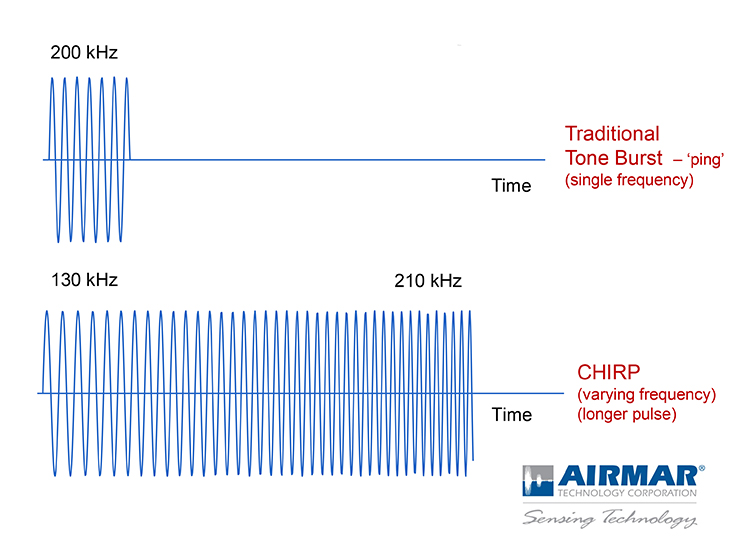
CHIRP fishfinders transmit a longer pulse than traditional sonar, putting more energy into the water column, with a true broadband frequency range of up to 117kHz.
Instead of pinging a single frequency like traditional 2D sonar, CHIRPing devices transmit a sweeping range of frequencies. With each pulse, the transducer starts vibrating at a low frequency, which is then modulated upward to a high frequency over the duration of the pulse (130 to 210kHz, for example).
A traditional sonar transmits about one percent of the time, but CHIRP sonars transmit ascending pulses that are ten times as long in duration. They put dramatically more energy into the water column, 10 to 50 times more, even though CHIRP devices often transmit at lower peak power than traditional fishfinders.
Pulse Compression and Pattern Correlation
Using advanced digital pattern matching and signal processing, known as “pulse compression,” CHIRP devices receive and process dramatically more information from each pulse, enabling them to achieve unprecedented resolution and target definition.
The pulse compression process, used in both radar and sonar systems, converts a long duration frequency-coded pulse into a narrow pulse of highly increased amplitude. A narrow pulse with high peak power can be correlated from a long duration pulse with low peak power, increasing the range resolution and improving the signal to noise ratio, giving the device greater ability to pull targets from the background noise.
CHIRP improves bottom tracking at higher speeds and deeper depths. It helps resolve individual targets—no blobs, but instead crisp separation of adjacent objects. The result is a spectacular improvement in the image you see.
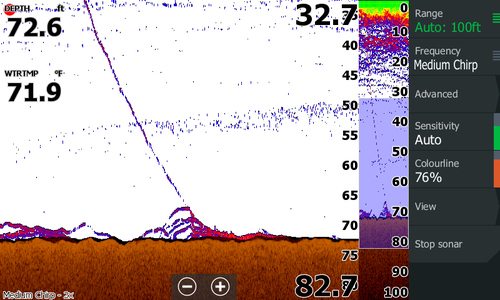
View on medium CHIRP showing fishing line.
CHIRP Frequencies
Which CHIRP frequencies should you choose? Here's how the three bands break down by depth and use case:
- High CHIRP (150–250 kHz) is for shallow water, roughly 0–150 feet. Best choice for lure tracking, identifying game fish and baitfish targets, or for targeting game fish near bottom structure — it delivers the clearest and most detailed images but loses effectiveness as depth increases.
- Medium CHIRP (80–160 kHz) covers shallow to medium depths, roughly 15–300 feet. It displays a wider coverage area, scanning large areas more quickly and showing larger fish arches, but with less fine detail than high CHIRP for spotting smaller objects. This is the best balance of range and clarity for most inshore and coastal fishing.
- Low CHIRP (below 80 kHz, typically 40–75 kHz) is built for deep water beyond 300 feet, with capability down to 10,000 feet in the right conditions. It penetrates far deeper and marks targets throughout the water column, but at the cost of the fine detail high and medium CHIRP provide.
Better quality CHIRP fishfinders let you see two CHIRP frequencies on screen at once. So you can sweep a broad cone on the medium frequency CHIRP band. Then, when you find something that looks good, get a closer look on the tighter-focused high CHIRP setting.
The Arrival of “Cheap CHIRP”
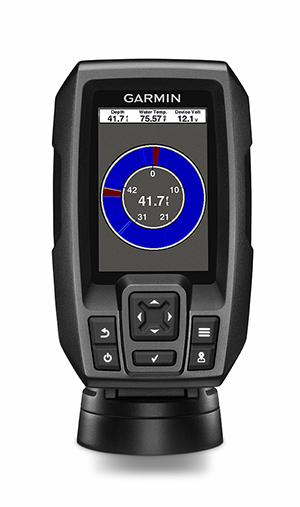
Garmin's Striker™ 4 Fishfinder includes a dual beam 77/200kHz CHIRP sonar, a color display and GPS to mark your favorite fishing spots.
How affordable are these CHIRP-enabled fish finders, and what are the differences across the range of prices for a CHIRP sonar?
When this technology first showed up on the market, CHIRP could only be found in expensive sonar modules costing a couple thousand dollars. They were made for the pros and for offshore fishermen looking for the latest technology, regardless of price. Today, CHIRP fishfinders, either sonar modules or chartplotter/fishfinder combos, are available in every price range.
Here are some of the premium features found on the most expensive offshore CHIRP sonar modules:
- Two independent CHIRP channels: Operate two independent transducers or one transducer covering two CHIRP frequency ranges, with ultra-low, low, medium, or high frequencies, to suit your style of fishing and the species you target
- Ability to customize frequencies: A traditional fixed frequency mode allows you to manually adjust frequencies (from 25kHz to 210kHz, using the Garmin GSD™ 26 CHIRP Professional Sonar Module, for example) for enhanced targeting of specific fish species
- Lots of transmitting power: Adjustable from about 300 RMS watts all the way to 3kW or 4kW, for extreme depth ranges
- Compatibility with many transducers: These include Airmar’s latest wide-angle 25° CHIRP series
- Part of an NMEA 2000 network: These modules work with high-end displays as one component of a network. A large, high-resolution LCD display is necessary to see all of the details from the powerful CHIRP sonar
Mid-priced CHIRP fishfinders often include a single CHIRP channel, usually with a transmitting power of 500W or 600W. Scanning sonar, enhanced with CHIRP technology, is often built into the unit and its matched transducer. You can see CHIRP, side-scan and down-scan sonar, all on the same screen. For the typical inland or coastal angler, these fishfinder/chartplotter combos have all the functions you’ll ever need. Two versions are often sold; a coastal model, with appropriate mid/high-frequency transducer and coastal charts, or an inland version with high-frequency transducer and inland lake charts. The price is often proportional to the size and resolution of the LCD screen.
Affordable CHIRP sonars, the “cheap CHIRP” for the rest of us, are made for the inland angler, and are the newest on the market. Various models come as a standalone fishfinder, sonar with GPS (but without charts), or a sonar/chartplotter including either inland or coastal maps.
Whatever your price range, CHIRP sonar has changed the fishfinding game.
A Note on Brand Names
Brand names for scanning sonar technologies vary by manufacturer — Garmin uses ClearVü (down) and SideVü (side), Lowrance uses StructureScan, and Raymarine uses DownVision and SideVision. The underlying technology is similar across brands; the key specs to compare are frequency, transmit power, and maximum range.
Glossary of Terms
CHIRP: An acronym for Compressed High-Intensity Radiated Pulse, a sonar technology that transmits a sweeping range of frequencies in a single pulse rather than one fixed frequency, producing significantly higher resolution and target separation than traditional sonar.
Down-Scan Sonar: A high-frequency scanning sonar technology that produces a photo-like image of the water column and bottom structure directly beneath the boat, marketed under different brand names depending on manufacturer.
NMEA 2000: A standardized communication protocol used by marine electronics manufacturers that allows devices like sonar modules, GPS, and instruments to share data over a single networked cable system.
Pulse Compression: A signal processing technique that converts a long-duration, frequency-swept pulse into a narrow pulse of much higher amplitude, improving range resolution and the ability to distinguish real targets from background noise.
Side-Scan Sonar: A scanning sonar technology that images the water column and bottom to the left and right of the boat rather than directly beneath it, useful for locating structure and fish outside the boat's direct path.
Target Separation: A sonar system's ability to distinguish between two objects that are close together in depth or proximity, displaying them as distinct returns rather than a single blurred mass.
Transducer: The underwater component of a sonar system that converts electrical energy into sound pulses and converts returning echoes back into electrical signals for the display to interpret.
FAQs
CHIRP (Compressed High-Intensity Radiated Pulse) sonar is a technology used in marine depth sounders that provides a more detailed and clearer picture of what’s below the boat. Instead of emitting a single frequency like traditional sonar, CHIRP sonar sends a range of frequencies (low to high) at once. The sonar system then interprets the returning echoes from these varied frequencies to create a higher resolution, more accurate image of the underwater environment. This improves fish detection, structure imaging, and bottom profiling.
CHIRP sonar has several key advantages: improved image quality with more detailed, sharper, higher-resolution images that make it easier to distinguish between fish and structure; better depth and target separation, especially in deeper water; extended range, detecting fish and structure at greater depths than traditional sonar while still providing clear images in shallow water; and less interference, since the broader frequency range reduces interference from other sonar systems.
Yes, a specialized CHIRP transducer is required to take full advantage of CHIRP sonar technology. Traditional sonar transducers operate at a fixed frequency, while CHIRP transducers can transmit and receive across a sweeping frequency range. These transducers are designed to handle the wide frequency ranges needed for CHIRP, ensuring you get the maximum performance from your sonar system.
Fish typically appear as arches or solid symbols depending on display settings, with the size and shape giving a rough indication of fish size and depth. The bottom shows as a line that varies in depth, with structures like rocks, wrecks, or reefs appearing as distinct shapes. Schools of fish appear as dense clustered masses, while individual fish show more distinctly. Most modern displays use color coding to represent return signal strength — warmer colors like reds and yellows indicate strong returns from solid objects or fish, while cooler colors like blues and greens indicate weaker returns from softer or less defined objects.
It depends on the depth you're fishing. High CHIRP (150–250 kHz) is best for shallow water, roughly 0–150 feet, providing the clearest and most detailed images. Medium CHIRP (80–160 kHz) is ideal for shallow to medium depths, roughly 15–300 feet, offering a good balance between range and clarity. Low CHIRP (below 80 kHz) is best for deeper water beyond 300 feet, penetrating much deeper but with less fine detail than the higher frequencies.
We’re Here to Help!
West Marine carries CHIRP fishfinders and sonar modules across every price range, from entry-level standalone units to professional offshore sonar systems. Browse our full selection of marine electronics and navigation gear below, or click on our handy store locator to find a West Marine store near you.
Browse All Marine Electronics & Navigation Gear
- Chartplotters, GPS units, radar systems, and integrated navigation displays
- Sonar, CHIRP, downscan, and fish-finding electronics
- Marine stereos, speakers, amplifiers, and audio accessories
- VHF radios, AIS, satellite communication equipment
- Autopilot systems and steering control components
- Wind, depth, speed, and multifunction instruments
- Marine binoculars for navigation and low-light use
- Thermal and night-vision devices for situational awareness
- Onboard monitoring and security systems
- Magnetic and electronic compasses
- Paper and electronic navigation charts
- Regional cruising and harbor guides
- Traditional navigation plotting tools


