Floating Locator Electronic SOS Beacon Kit





Complete Your Purchase


Orion Electronic SOS Beacon Locator Kit: The Ultimate Day and Night Distress Signal
Traditional marine pyrotechnic flares have defined emergency signaling on the water for over a century — but they come with significant limitations that become critical precisely when you can least afford failure. Flares expire and must be replaced on a regulatory schedule. They are single-use — once fired, they're gone.
They involve open flame and hot burning material in a survival situation where the person holding them may be injured, in a life raft, or in the water. They require dry storage and careful handling, and their regulatory shelf life means ongoing replacement cost regardless of whether they've ever been used.
The Orion Floating Locator Electronic SOS Beacon Kit addresses every one of these limitations with a fundamentally different approach to emergency visual signaling — a reusable, battery-powered electronic distress beacon that meets USCG requirements for both day and night visual distress signals, operates for over 50 continuous hours on standard D-cell batteries, floats and self-rights in the water, and requires no special handling, no expiration replacement cycles, and no open flame.
This is not a novelty electronic safety product — it is a USCG-certified, independently tested distress signaling device that meets the legal and performance requirements for visual distress signals under US Coast Guard regulations, engineered for the specific demands of marine emergency use.
The Case for Electronic Over Pyrotechnic — Understanding the Tradeoffs.
The decision between pyrotechnic flares and an electronic beacon alternative deserves careful consideration. Both have roles in a comprehensive safety kit, and understanding what each does and does not provide helps boaters make informed decisions:
Pyrotechnic flares produce an extremely bright signal (thousands of candela) visible at very long distances for a short duration — typically 60 seconds for a handheld flare, a few seconds for a parachute flare. Their short, intense burn makes them effective for attracting immediate attention over long distances when a searching vessel or aircraft is in the general area. However, their single-use nature, expiration requirements, open-flame hazard, and storage demands are genuine operational limitations.
The Orion Electronic SOS Beacon produces a sustained, consistent 75-candela SOS signal for over 50 continuous hours — a different performance profile optimized for sustained visibility during extended rescue operations rather than a brief, high-intensity burst. Where a pyrotechnic flare alerts a searcher to your position in a single moment, the electronic beacon maintains your position marker continuously throughout the search period, guiding rescuers to you over an extended timeframe. For coastal and offshore boaters, having both a brief high-intensity signal and a sustained electronic beacon provides a more complete emergency signaling capability than either alone.
USCG-Certified for Legal Compliance — Day and Night Visual Distress Signals.
The Orion Electronic SOS Beacon carries full USCG certification covering both required distress signal categories:
- Night Visual Distress Signal: Meets all US Coast Guard requirements under 46 CFR 161.013 for night visual distress signals. This is the critical regulatory certification — federal law requires recreational vessels operating on coastal waters, the Great Lakes, and territorial seas to carry night visual distress signals. The Orion beacon satisfies this requirement legally and completely.
- Day Visual Distress Signal: The included orange distress flag meets USCG requirements under 33 CFR 175.130 for daytime visual distress signals. Together with the electronic beacon for night use, the kit provides a complete day-and-night legal distress signaling solution in a single package.
- Independent Testing: All certifications have been independently verified by Imanna Laboratories — a US Coast Guard-approved independent test laboratory. Independent testing confirmation is a meaningful quality assurance distinction — it means the performance claims have been validated by a third party operating under USCG oversight, not simply self-certified by the manufacturer.
Morse Code SOS Signal — International Emergency Standard.
The beacon does not flash randomly or in a proprietary pattern — it transmits the internationally recognized SOS distress signal in Morse code (three short flashes, three long flashes, three short flashes: · · · — — — · · ·). This pattern is universally understood by Coast Guard personnel, maritime rescue coordination centers, commercial vessel watch officers, and search aircraft crews as a distress signal requiring immediate response. Any rescuer who sees this signal understands immediately that they are looking at a vessel or person in distress — there is no ambiguity, no need for interpretation.
Runtime Performance That Exceeds USCG Requirements — By a Significant Margin.
The Orion beacon's performance against USCG runtime requirements is worth understanding precisely:
- USCG Continuous Runtime Requirement: The regulatory baseline for certified night visual distress signals
- Orion Beacon Actual Runtime: Flashes twice as long as the USCG continuous runtime requirement
- Orion Beacon Intensity Duration: Maintains constant intensity at two-and-a-half times longer than the USCG requirement
- Stated Runtime: Over 50 hours of continuous SOS flashing operation
This substantial margin above the regulatory minimum is not marketing language — it is a meaningful safety buffer. A rescue operation that extends through the night and into the following day, or through multiple tidal cycles, or through deteriorating weather that delays search assets, benefits directly from a beacon that continues to operate long after minimum-specification devices would have exhausted their battery. Fifty-plus hours of continuous operation means the Orion beacon will still be functioning and signaling when rescuers finally reach your position.
75 Candela Output — Sustained, Consistent Brightness.
The beacon produces up to 75 candela of light output in the SOS flash pattern. Unlike pyrotechnic flares whose output diminishes as they burn, the electronic beacon maintains consistent candela output throughout its operating life — the 75th hour of operation looks the same to a searching vessel as the first. This consistency is operationally significant: a signal that dims progressively over time becomes harder to locate over distance as the rescue operation extends, while a consistent signal maintains its range and detectability throughout.
Floats 4 Inches Above Waterline — Optimized Visibility from the Water.
One of the most important and least-discussed aspects of maritime emergency signaling is the height of the light source above the waterline. A signal source at or near the waterline is easily obscured by wave action, chop, and swell — a 2-foot wave between the beacon and a searching vessel completely blocks a waterline-level signal. The Orion beacon is designed to float with the light source 4 inches above the waterline — enough elevation to maintain visibility over moderate wave action and chop, significantly improving the probability that the signal reaches a searching vessel's line of sight despite sea state.
Three Deployment Modes — Maximum Operational Flexibility.
The Orion beacon is designed to function effectively in three distinct deployment scenarios, each appropriate for different emergency situations:
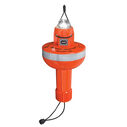
- Overboard Float: Drop the beacon overboard and it self-rights and floats with the light elevated 4 inches above the waterline, transmitting the SOS signal continuously. This mode is ideal for man-overboard situations, abandoning ship into a life raft, or any scenario where the beacon needs to mark a position autonomously.
- Hand-Held: Molded-in plastic handles allow the beacon to be held and raised for maximum elevation — increasing the signal's visible range by raising it above the wave action and vessel structure. Hand-holding the beacon also allows the user to orient it toward a searching vessel.
- Suspended/Hung: Provided lanyards allow the beacon to be hung from rigging, a life raft arch, or any elevated structure — combining the elevation benefit of hand-holding with hands-free operation during an extended signaling period.
Self-Righting Float Design — Functions Without Operator Action.
The beacon's buoyancy and weight distribution are engineered to self-right automatically when placed in the water — the beacon will always orient with the light elevated and signal transmitting, regardless of how it enters the water. This self-righting capability is critical for man-overboard or incapacitation scenarios where the device may need to function without any ongoing operator intervention.
SOLAS-Grade Reflective Tape — Passive Visibility Enhancement.
In addition to the active electronic signal, the beacon incorporates SOLAS-grade reflective tape — the same reflective specification required on commercial life-saving appliances. SOLAS reflective tape returns a significantly stronger signal to a spotlight, searchlight, or helicopter searchlight than standard recreational reflective material, providing passive visibility enhancement that continues to function even if the battery is depleted or the device is switched off. In a nighttime search, a spotlight sweep that catches the SOLAS tape provides an immediate position fix regardless of the beacon's active status.
Orange Distress Flag — USCG-Compliant Daytime Signaling.
The included orange distress flag meets USCG requirements under 33 CFR 175.130 for daytime visual distress signals — the mandatory orange distress flag specification for recreational vessels on coastal and offshore waters. Combined with the beacon's nighttime electronic signal capability, the flag completes the kit's day-and-night signaling compliance, providing a single-package solution for the full USCG visual distress signal requirement.
Reusable — No Expiration Date, No Replacement Cycles.
Unlike pyrotechnic flares, which carry a 42-month USCG-mandated expiration from date of manufacture and become non-compliant (and therefore useless for legal purposes) regardless of whether they've ever been used, the Orion electronic beacon has no expiration date. Replace the D-cell batteries periodically (the low battery indicator will alert you when replacement is needed), and the beacon remains fully functional and legally compliant indefinitely. Over a five-to-ten year ownership period, the elimination of recurring pyrotechnic flare replacement costs represents meaningful savings — in addition to the environmental benefit of not disposing of expired pyrotechnic devices.
Waterproof Microprocessor Electronics — Fully Encapsulated.
The electronic control system is fully encapsulated in waterproof resin — not merely sealed in a housing, but completely surrounded by protective material that prevents water intrusion regardless of the condition of external seals. This encapsulation approach is the most robust waterproofing method available for electronic devices in immersion environments, ensuring the control electronics function correctly even after the beacon has been dropped overboard, rained on, or stored in a wet equipment locker.
Double O-Ring Battery Compartment Seal.
The battery compartment — the most vulnerable water intrusion point in any battery-powered device — is sealed with a double O-ring closure. Two independent O-ring sealing surfaces mean that failure of one seal does not result in water reaching the batteries. The double seal also provides clear tactile and visual feedback during closure that both seals are properly seated — eliminating the uncertainty of single-seal designs.
High-Impact ABS Plastic Construction.
The beacon body is high-impact ABS plastic in high-visibility orange — a material combination that provides the impact resistance needed to survive being dropped on a deck, thrown overboard, or tumbled in a life raft, while maintaining the dimensional stability and UV resistance required for outdoor marine storage. The orange color provides passive daytime visibility independent of the flag or electronic signal.
Low Battery Indicator — Know Your Status Before You Need It.
A dedicated low battery indicator alerts the user when the D-cell batteries are approaching depletion — allowing proactive battery replacement during routine inspection rather than discovering a depleted battery during an emergency activation. Pair this indicator check with your regular safety equipment inspection for complete assurance of readiness.
Reusable Storage Container — Protected and Ready.
The included reusable storage container keeps the beacon protected from physical damage, UV exposure, and contamination during storage, while keeping it organized and immediately accessible in an emergency. A clearly labeled, dedicated storage location means no searching for safety equipment when seconds matter.
Inspect the Orion beacon before every offshore passage and at minimum annually. Check battery condition, verify O-ring seals are clean and properly seated, test the on/off switch function, inspect SOLAS tape for damage, and confirm the distress flag is present and intact.
Key Features:
- Reusable Storage Container: Keeps the beacon handy and protected when not in use.
- Extended Light Source: Stays visible for over 50 hours of continuous operation, illuminating up to 75 Candela of brightness.
- Compliance and Certification: Meets all U.S. Coast Guard requirements for "Night Visual Distress Signals" (46 CFR 161.013) and is independently tested by U.S. Coast Guard-approved Imanna Labs.
- Versatile Deployment: Can be dropped overboard to self-right and float, held in hand with easy-to-grip molded-in plastic handles, or hung from your boat using the provided lanyards.
- Day and Night Visibility: Equipped with an orange distress flag that complies with U.S. Coast Guard requirements for daytime signaling (33 CFR 175.130).
Specifications:
- Dimensions: 12" H x 5.5" Dia.
- Weight: 1.5 lbs
- Burn Time: Over 50 hours of continuous operation
- Brightness: Up to 75 Candela
The Orion Electronic SOS Beacon Locator Kit is your reliable, high-visibility solution for emergency situations on the water. With multiple deployment options and durable construction, it's designed to enhance safety and ensure you’re prepared for any situation.


