Winterizing your diesel engine(s) is a step-by-step process. When you’re done, your engine will have clean oil, stabilized fuel, and a cooling system that’s either completely drained or filled with antifreeze. You will have inspected key components, covered all openings, left visible reminder notes, and listed all required repairs. Your engine will be ready for spring commissioning with a minimum of hassle. Your diesel marine generator also needs to be winterized, and most of the steps are the same ones you need to take to winterize your boat’s diesel propulsion engine.
Easily done. Let’s get started.
- Stabilize the Fuel
- Change the Oil
- Coat the Cylinders with Oil
- Winterize the Cooling System
- Two Types of Antifreeze
- Three Levels of Concentration
- Check the Engine Exhaust
- Inspect Hoses
- Seal Engine Openings
- Miscellaneous Jobs
- FAQs
Stabilize the Fuel
Check your fuel-water separator for sediment and water, and clean or replace the filter elements as needed. A clogged separator going into winter storage means a fouled fuel system in spring before you ever turn the key. Fill your tank 95% full with clean diesel — a nearly full tank minimizes the air space above the fuel, which reduces condensation and slows the growth of microorganisms in the tank during the lay-up period. Add a quality fuel stabilizer; Biobor JF and Star Tron Diesel Additive are well-regarded options recommended by Practical Sailor, and West Marine also carries ValvTect BioGuard and STA-BIL Diesel. Run your engine long enough to fully distribute the stabilizing additives throughout the entire fuel system — this means running it until the temperature gauge reaches normal operating temperature, not just idling for a minute at the dock.
Change the Oil
Change the engine’s oil and replace the oil filter. Why do this now instead of waiting until spring? Because old, used oil contains combustion byproducts, acids, and metal particles that will attack engine bearings, cylinder walls, and gaskets during a long lay-up. Oil chemistry degrades over time even in a stationary engine, and acids that are neutralized by fresh oil additives become increasingly corrosive as the additives are depleted. Clean oil going into winter is significantly better for engine longevity than fresh oil going in at commissioning time. Change the transmission fluid too, for the same reason — transmission fluid also accumulates water and acids over a season of use.
Be sure to first run the engine up to full operating temperature before draining. Warm oil flows more freely and carries the suspended contaminants out with it far more effectively than cold oil. An oil extractor pump makes the job cleaner and easier than removing the drain plug in a confined engine compartment.
Coat the Cylinders with Oil
With the engine warm and freshly oiled, spray a fogging oil or light machine oil into the inlet manifold. Then crank the engine over several times without starting it — most diesel ignitions allow you to disengage the fuel rack or shut off the fuel supply to prevent starting while still cranking. This distributes the oil over the cylinder walls, piston rings, and valve stems, creating a protective film that prevents oxidation and corrosion on these critical surfaces during the months the engine sits unused. The cylinder walls are particularly vulnerable during lay-up because the oil film from normal operation drains down over time, leaving bare metal exposed to humid air.
Winterize the Cooling System
Freshwater-cooled engines with a heat exchanger: Replace the coolant in the freshwater closed-loop side of the system. This is an important task because the antifreeze in a freshwater-cooled diesel also contains corrosion inhibitors that protect the aluminum, iron, copper, and brass in the cooling circuit. The antifreeze itself doesn’t wear out, but the inhibitor package does — typically after two years of service. Replacing it at each winter layup is the right interval for most engines. If you’re using a coolant that requires dilution, prepare the correct concentration first, then add it to the system. Follow the manufacturer’s dilution instructions precisely; undiluted full-strength coolant actually has a higher freeze point than properly diluted coolant.
Raw water cooling system: There are two acceptable approaches. The first is to drain the entire system thoroughly, being careful to leave no standing water in any low spot. Diesel engines have many low pockets in the cooling passages where water collects and cannot drain by gravity alone — a single pocket of trapped water that freezes can crack a cast iron block or head. To drain, consult the owner’s manual for the location of all petcocks and open every one of them. If water fails to drain freely from a petcock, it may be clogged with rust or debris — remove the petcock and clear the opening before proceeding. Also drain the sea strainer body, the seacock interior, and the water lift muffler if installed. This method works, but requires absolute thoroughness — a missed pocket is an expensive repair.
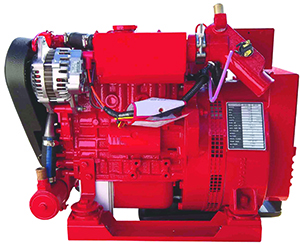
This diesel generator gets the same treatment as the main propulsion engine.
The second approach — and the one we prefer — is to flush the raw water system with antifreeze. This is more reliable than draining because it protects against any residual water in low spots rather than depending on complete drainage. To circulate antifreeze through the raw water side:
- Fill a five-gallon bucket with undiluted non-toxic propylene glycol antifreeze. Have at least one additional gallon on hand if you haven’t done this before or if your engine has an unusually large raw water system. Any leftover antifreeze can be used in the boat’s freshwater plumbing and sanitation systems.
- If the boat is in the water, close the intake seacock completely before proceeding.
- Remove the raw water intake hose from the seacock fitting and insert the open end of the hose into the antifreeze bucket. This is sometimes difficult because hose clamps and hoses may be stuck from extended heat cycling — work them loose carefully without damaging the hose.
- Start the engine and run at idle. Watch the exhaust outlet for the discharge of pink antifreeze, then continue running for 30 seconds or more after antifreeze appears. This confirms that the antifreeze has purged all the raw water from the heat exchanger, water pump, and exhaust cooling passages.
- Shut down the engine and reconnect the raw water intake hose securely to the seacock fitting.
Two Types of Antifreeze
There are two types of antifreeze, and it is critical to use the right one. The common automotive antifreeze, such as Prestone or Zerex, is ethylene glycol-based. It’s formulated for closed cooling systems in cars and trucks, where it stays in the system indefinitely. It is highly toxic to animals, people, and the aquatic environment. It must never be used in the raw water circuit of a marine engine where it can discharge into the water.
For raw water system winterization, always use non-toxic propylene glycol antifreeze — the pink marine and RV antifreeze available at West Marine. Propylene glycol has a much lower toxicity profile and is far safer if it discharges into storm drains or the surrounding water during the winterizing process. West Marine brand antifreeze is premium “virgin” propylene glycol, meaning it has not been recycled and reprocessed from waste antifreeze. It also contains corrosion inhibitors to protect the metals in the cooling system during the lay-up period.
Three Levels of Concentration
Propylene glycol antifreeze is available in -50°F, -60°F, and -100°F formulations. For winterizing marine engine raw water systems, always use the highest concentration available: the -100°F formula. The reason is dilution: there is always residual fresh water inside the engine cooling passages even after the system has been drained or flushed. When the -50°F antifreeze enters a system with residual water, the two mix, and the resulting solution may freeze at a temperature significantly warmer than -50°F. What goes in as -50°F rated antifreeze may come out with an effective freeze point of -20°F or higher, depending on how much water remains. Using the -100°F formula provides enough margin that even after dilution by residual water, the resulting mixture still protects well below the freeze point you will encounter.
One important characteristic of non-toxic propylene glycol antifreeze: it has a “slush point” that is significantly warmer than its freeze point. For the -50°F product, the slush point is approximately +11°F. At the slush point, the antifreeze thickens but does not freeze solid and will not crack engine components — this is normal and acceptable behavior. Full freezing and the expansion that causes cracking does not occur until the temperature drops below the rated freeze point.
Some experienced mechanics also advise removing the raw water impeller from its pump housing before storage. Lubricate the impeller vanes and pump bore with a light coating of petroleum jelly, reinstall the impeller, and replace the pump housing cover — but leave the cover screws finger-tight rather than fully tightened. This prevents the rubber vanes from bonding to the pump housing during the lay-up, which can cause the vanes to tear when the engine is started in spring. Alternatively, remove the impeller entirely and store it separately so its vanes cannot take a set from being compressed against the housing for months. Leave a large, visible reminder note on the engine or throttle to reinstall and/or tighten the impeller cover before starting in spring — running a raw water pump without an impeller for even a few seconds can cause serious damage. For detailed impeller service instructions, see the West Advisor article Impeller Replacement 101.
Check the Exhaust System
Break the exhaust connection loose from the water lift muffler or exhaust manifold and inspect the interior for carbon buildup or corrosion. Heavy carbon buildup can indicate a combustion problem that should be addressed before spring. Inspect the raw water injection hose — the hose that injects cooling water into the exhaust stream to cool it. Remove it from the injection nipple and look for blockage from scale, debris, or collapsed hose interior. A restricted water injection hose causes the exhaust to run too hot and can damage the exhaust hose and muffler. While you have the exhaust system open, inspect the exhaust hose itself for heat damage, cracking, or delamination of the inner liner.
Inspect Hoses
Check all hoses throughout the engine compartment for softness, bulging, cracking, or surface crazing. Pay particular attention to the hot side of the cooling and exhaust circuits — these hoses experience the most thermal stress and fail most frequently. Squeeze each hose firmly with your hand. A healthy hose is firm and resilient; a degraded hose is soft and squishy, or hard and brittle. Either extreme means the hose needs replacement before commissioning. Check all hose clamps for tightness and look for rust staining, which indicates a clamp made from inferior steel that is corroding in the marine environment — replace any corroded clamps with marine-grade stainless clamps.
Seal Engine Openings
Seal all engine openings to prevent humid winter air from entering the engine interior. Moisture inside the engine promotes corrosion on the cylinder walls, valve stems, and other metal surfaces. Use plastic bags, cut plastic containers, and tape to cap the air inlet, transmission and crankcase breathers, and exhaust outlets. Make a written list of every opening you have sealed — tape it prominently to the throttle or engine panel — so you have a complete checklist to work from when uncapping in spring. Missing a single sealed opening and starting the engine can cause serious damage.
Miscellaneous Jobs
- Stuffing box (if stored in the water): Tighten the stuffing box packing nut to eliminate all dripping during the lay-up. The boat will not be moving, so there is no concern about overheating from inadequate cooling water flow. Leave a clear reminder note to re-loosen the packing in spring before operating the engine — a stuffing box that is too tight will overheat during operation and can damage the cutlass bearing and shaft.
- Motor mounts: Inspect the motor mounts and check their flexible rubber elements for softening, cracking, or oil contamination. Engine and transmission oil that contacts rubber motor mounts causes them to swell and soften, eventually causing the engine to shift position under load and potentially damaging shaft alignment.
- Grease points: Lubricate all engine grease fittings. Consult the engine manual for the location of all Zerk fittings on the alternator, water pump, and other components.
- Control cables: Remove throttle and shift control cables from their housings and apply a coat of corrosion-inhibiting grease before reinstalling. Cables that are not lubricated at lay-up often corrode in their housings over winter and become stiff or unresponsive in spring — a stiff throttle cable is a safety issue underway.
- Spring maintenance list: Note all damage found during inspections and all required repairs or maintenance. Get repairs completed before commissioning if possible. Rust, worn belts, leaking injectors, and cracked mounts are all easier and less expensive to deal with before the season than after you’re already trying to launch.

Marine Diesel Winterizing FAQ
Used engine oil contains combustion acids, metal particles, and degraded additives. These contaminants attack bearings, cylinder walls, and gaskets over a long lay-up, even when the engine is not running. The acids in used oil continue chemically reacting with metal surfaces throughout the winter. Fresh oil going in at lay-up gives you clean, properly buffered lubricant protecting the engine for the entire off-season. Change the transmission fluid for the same reason — it also accumulates water and acids over a season.
No. Automotive antifreeze is ethylene glycol-based and highly toxic to people, animals, and the aquatic environment. It must never be used in a raw water system where it will discharge into the surrounding water. For raw water system winterization, always use non-toxic propylene glycol antifreeze (the pink marine and RV antifreeze). Ethylene glycol antifreeze can be used in the closed freshwater loop of a heat exchanger system, but never in the raw water side.
Because there is always residual water inside the engine cooling passages, even after draining or flushing. When -50°F antifreeze enters a system with residual water, the two dilute each other, and the resulting mixture may have an effective freeze point of -20°F or warmer. The -100°F formula provides enough concentration that even after being diluted by trapped water, the mixture still protects well below the freeze temperatures you will actually experience. Using a lower concentration is false economy that can result in a cracked block.
Yes, or at minimum loosen the pump housing cover. A rubber impeller that sits compressed against the pump housing for months will develop permanent set in its vanes — the vanes no longer spring back to their working shape — and may tear when the engine is started in spring. The best practice is to remove the impeller entirely and store it in a sealed bag with a small amount of petroleum jelly, then reinstall fresh in spring. If you leave it in, loosen the housing cover screws so the vanes are not under compression against the bore. Leave a prominent reminder note either way, since running a pump without an impeller destroys it instantly.
Draining can be sufficient but is riskier than flushing with antifreeze. Marine diesel engines have many low pockets in the cooling passages where water collects and cannot drain by gravity. A single pocket of trapped water that freezes can crack a cast iron block or heat exchanger. The antifreeze method is more reliable because it protects any residual water rather than depending on perfect drainage. If you choose to drain, consult the engine manual for every petcock and drain point, and be absolutely thorough — incomplete draining is how expensive freeze damage happens.


