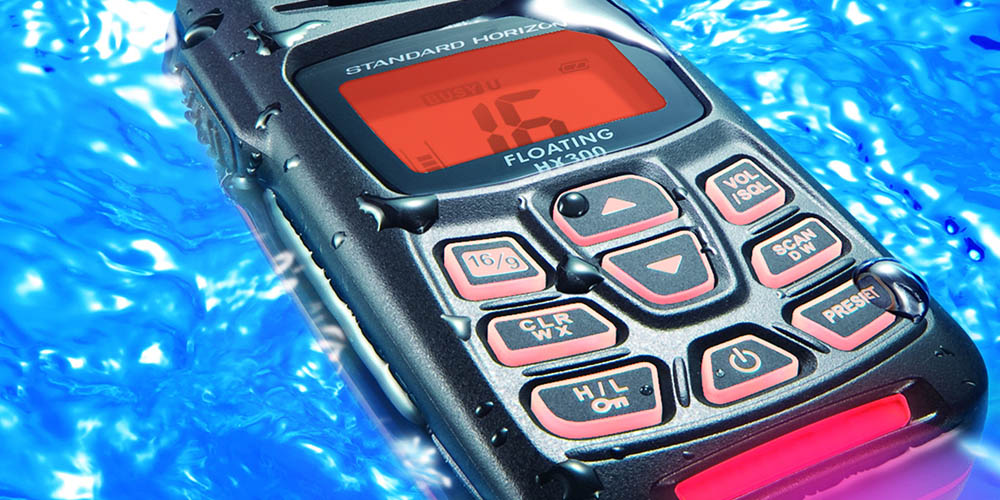
What does the term “waterproof” really mean? In our product presentations, we use an international standard (IEC 60529) that measures how effectively devices are protected from intrusion by foreign solid objects or liquids. Ingress Protection (IP) ratings — for example, IP65 or IPX7 — use two digits, each rated on a scale from 0 to 8. The first digit describes protection against solid objects; the second describes protection against liquids. The letter X is used where there is no rating for one of the two indices.
IPX7, the most common rating in our marine electronics catalog, means the device is not rated for protection against solid objects but is rated at a seven against liquids — meaning it can withstand immersion to 1 meter for 30 minutes. Understanding what that means in practice is more useful than just knowing the number.
One important caveat: IP ratings are self-certified by the manufacturer rather than tested by an independent organization like Underwriters Laboratories. The rating tells you what the manufacturer claims, not what a third party verified. This is why products from well-established marine electronics brands — Garmin, Lowrance, Raymarine, Standard Horizon, Icom — generally command more trust on their IP claims than unknown or budget brands: they have reputations to protect and documented field performance to support the ratings they publish.
- IP Rating Table
- What IP Ratings Mean for Marine Electronics
- Most Common Ratings on Boats
- IP Ratings FAQ
IP Rating Standards Table
| First Number: Solid Objects | Definition | Second Number: Liquids | Definition |
|---|---|---|---|
| 0 | No protection | 0 | No protection |
| 1 | Protected against solid objects over 50mm (accidental touch by hands) | 1 | Protected against vertically falling drops of water |
| 2 | Protected against solid objects over 12mm (such as fingers) | 2 | Protected against direct sprays up to 15° from vertical |
| 3 | Protected against solid objects over 2.5mm (such as tools and wires) | 3 | Protected against direct sprays up to 60° from vertical |
| 4 | Protected against solid objects over 1mm (tools, wires and small wires) | 4 | Protected against sprays from all directions. Limited ingress permitted. |
| 5 | Protected against dust. Limited ingress (no harmful deposit) | 5 | Protected against low-pressure jets of water from all directions. Limited ingress permitted. |
| 6 | Totally protected against dust | 6 | Protected against strong jets of water (for use on ship decks). Limited ingress permitted. |
| 7 | N/A | 7 | Protected against the effects of immersion at depth between 15cm and 1 meter. 30-minute test. |
| 8 | N/A | 8 | Protected against long periods of immersion at depth greater than 1 meter, specified by manufacturer. |
What IP Ratings Mean for Marine Electronics
The IP rating system was developed for industrial equipment but has become the standard by which marine electronics manufacturers describe water resistance. Here is what each relevant level means in a boating context:
IPX4 — Splash resistant. Protected against water splashed from any direction. This is the minimum meaningful rating for open cockpit use and is appropriate for fixed-mount electronics in well-protected helm positions where direct spray is unlikely. It is not adequate for helm electronics on open powerboats, sailboat cockpits in offshore conditions, or any location where the device might be hit by spray, rain, or wash from wave action.
IPX5 — Water jet resistant. Protected against low-pressure water jets from any direction. Appropriate for chartplotters and displays mounted at a helm that receives spray but is not routinely washed down. Most of today’s fixed-mount marine electronics meet at least IPX5.
IPX6 — Powerful water jet resistant. Protected against strong jets of water from any direction — the “ship deck” standard. An IPX6-rated device can withstand a direct high-pressure hosing, which is the relevant test for helm electronics on offshore powerboats and sailboats that regularly take spray over the bow. IPX6 is the minimum recommended rating for any marine electronics installed in an exposed location on a boat that operates in rough water or offshore.
IPX7 — Immersion rated. Protected against submersion to 1 meter for 30 minutes under the standard test. This is the rating you want for handheld devices — VHF radios, GPS units, handheld chartplotters — that could go overboard, be dropped in the bilge, or end up fully submerged in a wave wash. A rating of IPX7 means the device is designed to survive a brief submersion and keep working when retrieved. Most handheld VHF radios carried on boats should meet at minimum IPX7 — a radio rated only for splash resistance is essentially useless in the conditions where you most need it.
IP67 — Fully dust-tight and immersion rated. The first digit of 6 means completely dust-tight, the second digit of 7 means immersion-rated to 1 meter. Relevant for electronics used in dusty environments as well as wet ones. Less common in purely marine applications but seen in some handheld devices.
IP68 — Continuous submersion rated. Protected against extended immersion at depths greater than 1 meter, with the specific depth and duration specified by the manufacturer. An IP68-rated device can be used underwater continuously within the manufacturer’s specified limits. This rating is used for underwater cameras, submersible transducers, and certain premium handheld devices where extended underwater exposure is an intended use case. The specific depth and duration in the IP68 rating varies by manufacturer — one manufacturer’s IP68 rating may specify 1.5 meters for 1 hour while another specifies 10 meters for 30 minutes.
Most Common IP Ratings on Boats and What to Buy
The most common IP ratings you will encounter on marine electronics at West Marine:
- IPX6 or IP66: Fixed-mount chartplotters, fishfinders, and multifunction displays intended for exposed helm installations. The “6” liquid rating means a direct hosing or breaking wave can hit the display without causing damage. This is the standard for most quality fixed-mount marine electronics from Garmin, Lowrance, Raymarine, and Humminbird.
- IPX7: Handheld VHF radios, portable GPS units, and handheld fishfinders. The 1-meter/30-minute immersion standard is the practical minimum for any handheld device that might go overboard. West Marine recommends IPX7 as a baseline for any handheld radio, GPS, or emergency device carried on a boat.
- IP68: Submersible underwater cameras, certain premium handheld radios and GPS devices, and transducers rated for continuous underwater deployment. Check the manufacturer’s specific depth and duration claim, as these vary significantly between products.
- IPX4 or IPX5: Electronics in protected helm positions, chartrooms, or below-deck installations where direct spray is unlikely. Appropriate for electronics in protected pilothouse installations but not for exposed open-cockpit use.
A practical note about “waterproof” marketing language: Manufacturers sometimes use “waterproof” without specifying an IP rating, or use terms like “water resistant” and “splash proof” interchangeably. When evaluating a marine electronics purchase, always look for the specific IP rating number in the product specifications rather than relying on marketing language. A product described as “waterproof” may carry an IPX4 splash rating that is inadequate for offshore use, while a product described as “water resistant” may carry an IPX7 immersion rating that exceeds it. The number is what matters.
IP Ratings FAQ
IPX7 means the device has been tested to withstand submersion to 1 meter depth for 30 minutes under the IEC 60529 standard. The “X” means there is no solid object ingress rating. For a handheld VHF radio or GPS, IPX7 means the device is designed to survive being dropped overboard in shallow water and remain functional when retrieved. It is the minimum recommended rating for any handheld electronic device carried as safety equipment on a boat.
IPX6 is protection against powerful direct water jets from any direction — the ship deck standard. IPX7 is protection against full submersion to 1 meter for 30 minutes. Counterintuitively, IPX6 and IPX7 test for different things: a product rated IPX6 may not pass the IPX7 submersion test, and a product rated IPX7 may not pass the IPX6 high-pressure jet test. For a fixed-mount chartplotter at the helm, IPX6 is the relevant rating. For a handheld radio or GPS that might go overboard, IPX7 is the relevant rating. Some products carry both ratings (IP67) which means they meet both tests.
IP ratings are self-certified by the manufacturer, not independently verified by a third party like Underwriters Laboratories. The manufacturer conducts testing to the IEC 60529 standard and assigns the rating based on those results. This means the rating reflects the manufacturer’s claim about their own product rather than an independently audited result. Products from established marine electronics brands with long track records — Garmin, Icom, Standard Horizon, Lowrance, Raymarine — generally have more reliable IP claims than lesser-known brands because their products face real-world testing by thousands of users and they have reputations to protect.
For a fixed-mount VHF at an exposed helm, IPX6 or better is the appropriate minimum. For a handheld VHF carried as safety gear, IPX7 is the minimum — you want the radio to function if it goes overboard. Many offshore sailors carry handheld VHFs rated IPX7 or higher and tether them to their PFD or inflatable lifejacket harness so the radio stays with them if they go over the side. An IPX4 or IPX5 rated handheld radio is inadequate as primary safety equipment on any offshore boat.
IP68 means continuous submersion protection at depths greater than 1 meter, with the specific depth and duration set by the manufacturer. The first digit of 8 also means completely dust-tight. IPX7 covers immersion to 1 meter for 30 minutes. IP68 is a higher standard for the submersion test but the actual protection depends entirely on what depth and duration the manufacturer specifies — a device rated IP68 at 1.5 meters is not necessarily better protected than one rated IPX7, since the IPX7 standard also tests at 1 meter. Always check the manufacturer’s specific IP68 depth and time claim rather than assuming IP68 is uniformly superior to IPX7.
Browse Marine Electronics at West Marine
- Handheld VHF radios — IPX7 rated for offshore safety use
- Fixed-mount VHF radios for helm installations
- Fishfinders — sonar, CHIRP, and imaging units
- Chartplotters, GPS units, radar, and integrated navigation displays
- Marine stereos, speakers, amplifiers, and audio accessories
- VHF radios, AIS, and satellite communication equipment
- Marine binoculars for navigation and low-light use
- EPIRBs and PLBs — personal locator beacons and emergency position-indicating radio beacons