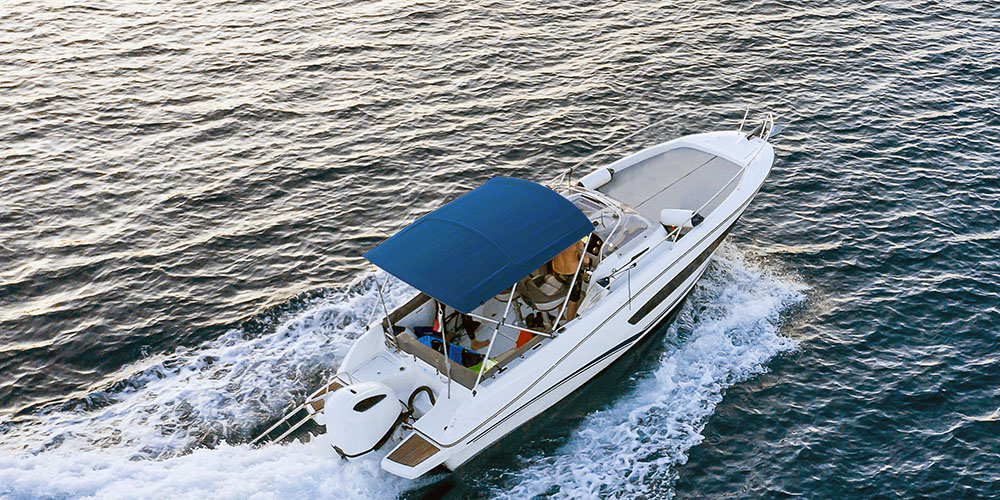
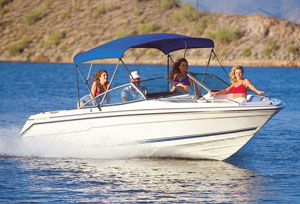
A bimini top is one of the most practical additions you can make to a boat. Unlike a full boat cover, a bimini is a partial cockpit cover supported by a folding aluminum frame — it provides shade while keeping the cockpit open for visibility, air circulation, and easy movement. It can be raised in seconds when the sun comes up and stowed flat when you want an unobstructed view or plan to run at high speed. Biminis are not just for powerboats: cruising sailors frequently use them for shade and light rain protection while at anchor.
Choosing the right bimini top involves four decisions that all interact: width (the distance between mounting points), length (how much cockpit area you want to shade), height (how much clearance you need to move underneath), and fabric. Getting these measurements right before ordering saves the frustration of a top that doesn’t fit or doesn’t provide the coverage you expected.
- What type of boat do you want to equip?
- Determine width
- Determine length
- Determine height
- Choose fabric type and color
- Storage boot
- Full-frame vs. knock-down construction
- FAQs
What Type of Boat Do You Want to Equip?
Competition ski boats and wake boats: Taylor Made Products offers model-specific tops for many configurations of Correct Craft, MasterCraft, and Malibu boats. West Marine also carries Ultima™ Tower Bimini Tops designed to mount within the framework of wakeboard towers. These are 48” long and approximately 16” tall from the mounting point, providing shade for the driver and spotter without requiring a full gunwale-mounted frame. They are available in several widths to fit most tower configurations. If your boat has an existing wakeboard tower, this is almost always the more practical option than a traditional bimini because it does not conflict with the tower structure and positions the shade exactly where the crew sits.
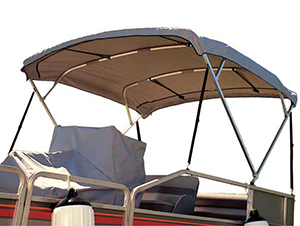
Square Tube kit for pontoon boats
Pontoon boat: Pontoon biminis use a square tube aluminum frame designed to match the square aluminum playpen railing found on most OEM pontoon boats. Round-tube bimini frames look mismatched against square pontoon railings, which is why pontoon-specific tops use square tube construction. West Marine pontoon biminis are 8’ (96”) long and 56” tall, include all-metal hardware, and are available in 96” or 103” widths. The 8’ length is appropriate for most pontoon boats because the cockpit area is large — a shorter bimini leaves significant seating area unshaded. The knock-down design allows the frame to be disassembled for storage or transport when needed.
Other powerboats and sailboats: For all other boats, you choose the dimensions and fabric independently. The following sections walk through each measurement and decision.
Determine Width: Distance Between the Mounting Points
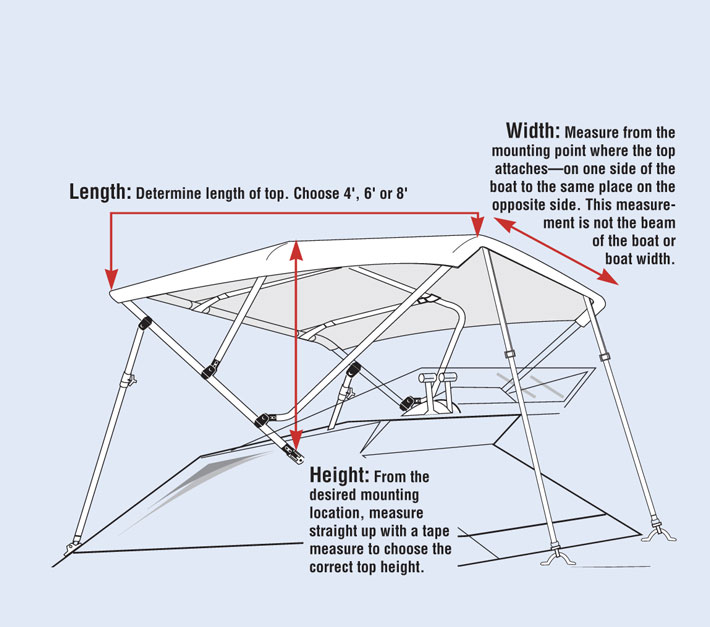
Width is the measurement that trips up the most first-time bimini buyers. The correct measurement is the distance from the bimini mounting point on one side of the boat to the same mounting point on the opposite side — not the beam width of the boat itself. These numbers are often significantly different.
Most biminis mount on the gunwale rail or on deck hardware positioned inboard of the actual outer edge of the hull. Measure at the specific location where the bimini’s swivel base fittings will attach, not at the widest point of the boat. If you measure at the hull edge and order to that dimension, the bimini frame will be too wide and the fabric will gap or the fittings will have nothing to mount to.
Bimini widths are available in increments of approximately 6”. Because aluminum bimini frames have some flexibility, a given width can accommodate mounting points that vary a few inches on either side of the nominal measurement — choose the width that most closely matches your actual mounting point span. If your measurement falls exactly between two available widths, order the wider size and allow the frame to sit slightly relaxed rather than the narrower size, which will put the frame under constant tension and fatigue the fittings.
Determine Length: How Much Shade Do You Need?
Length determines how much of the cockpit is shaded. Length options are 4’, 6’ or 8’. The right length depends on how many people you typically carry, where they sit, and how you use the boat.
- 4’ length: Shade for the helm only. Appropriate for solo fishing, racing, or any use where helm protection is the priority and cockpit traffic needs to be unobstructed. A short bimini at a taller height keeps the shade directly over the helm without creating an obstacle to people moving around the cockpit. Also appropriate for ski boats where the driver and spotter are the only people needing shade — skiers are behind the boat.
- 6’ length: The most versatile option. Covers the helm and rear seating area, providing shade for a typical group of 3–4 people. For boats under 20’ in overall length, this is the recommended maximum size — a longer bimini risks extending past the bow and creating clearance issues when folded or when running in a seaway with bow rise.
- 8’ length: Maximum coverage for larger boats with extended cockpits. Appropriate for boats over 22–24’ where the cockpit extends well aft of the helm. On pontoon boats, 8’ is the standard because of the open platform layout. An 8’ bimini on a boat under 20’ long will typically overhang the bow or transom in a way that looks wrong and can interfere with dock lines and other hardware.
Rule of thumb: If your boat is under 20’ in length, a 6’ top works best unless you have an unusually large cockpit area. Measure the cockpit from the helm seat back cushion to the stern transom to confirm which length fits your layout before ordering.
Determine Height: How Much Clearance Do You Need?
The listed height of a bimini top is the maximum standing height under the frame measured from the mounting point — not from the boat floor. This distinction matters significantly for installation planning.
If the bimini mounts on the gunwale, the actual standing clearance inside the boat equals the distance from the boat floor to the top of the gunwale plus the specified bimini height. A 42” bimini mounted on a gunwale that is 18” above the cockpit floor gives a total standing clearance of 60” (5’) — comfortable for most people to stand and move under. A 36” bimini on the same gunwale provides only 54” (4’6”) of clearance, which is fine for seated shade but forces anyone standing to duck significantly.
Height standard options are typically 36”, 42”, and 54” from the mounting point. For most recreational powerboats:
- 36” height: Provides a lower, more aerodynamic profile that holds better at higher speeds and in wind. Better suited to fast boats where clearance is secondary and you want the bimini to stay put when running offshore at 30+ mph. Also better for shorter cockpits where a taller top would look disproportionate.
- 42” height: The most common and most versatile height. Provides comfortable head clearance for most adults when combined with a standard gunwale height, and holds reasonably well at speed. The best all-around choice for most family runabouts, deck boats, and cruisers.
- 54” height: Maximum clearance for boats with lower gunwales or for boaters who want to move freely under the bimini without any ducking. More vulnerable to wind lift at higher speeds — best suited to slow-speed use such as sailing, anchoring, or leisurely cruising where the top remains up continuously rather than being deployed selectively.
Choose the Type of Fabric and Color
Bimini fabric determines UV protection, durability, water resistance, and how the top feels and looks after years of exposure. West Marine offers three fabric lines:
Ultima™ Fabric — available in Gray, Pacific Blue, Teal, Black, Cranberry, Navy, and Hunter Green
- Highest quality fabric available in the West Marine bimini line
- Urethane-coated polyester construction — the urethane coating provides waterproofing and UV resistance while the polyester base provides dimensional stability
- Solution-dyed at 7.0 oz. per square yard — solution dyeing means the color is part of the fiber structure rather than applied as a surface treatment, so it does not bleach or fade the way surface-dyed fabrics do under sustained UV exposure
- Less than 2% stretch, meaning the fabric holds its shape and maintains tension across the frame without sagging over time
- Mold and mildew resistant — important for stored and folded biminis that may sit damp in a cockpit locker between uses
Hot Shot™ Fabric — available in Gray, Teal, Pacific Blue, Cranberry, Navy, and Hunter Green
- Acrylic-coated polyester at 6.25 oz. per square yard — acrylic coating is lighter than urethane and provides good UV resistance without the weight or stiffness of heavier coatings
- Mildew and UV resistant — the acrylic coating sheds water effectively and resists mold growth under normal use
- Good for all climates — performs well in both hot dry environments and humid saltwater conditions
- Note: on some bimini models, the frame and fabric top are packaged separately, which can be an advantage if you already have a frame and want to replace only the fabric
Marine Vinyl — available in white only
- Traditional marine canvas material with decades of proven performance in the marine environment
- Waterproof by nature — vinyl does not absorb water, making it one of the most effective materials for rain protection
- Extremely easy to clean — most marks wipe off with soap and water; mildew can be removed with standard marine canvas cleaner
- OEM appearance — white vinyl biminis match the factory look of many production powerboats and are the traditional choice for restoring or replacing a factory top
- Heavier than the coated fabric options and less flexible in cold temperatures; more prone to cracking at fold lines over time in cold climates
Hot Shot zippered storage boot
Do You Want a Storage Boot?
A storage boot is a fabric sleeve that covers the folded bimini frame and fabric when the top is stowed. When a bimini is folded down, the frame, hardware fittings, and fabric are all exposed to UV, salt spray, and bird droppings. Without a boot, the fabric fades and mildews faster, the hardware corrodes sooner, and the overall life of the bimini is noticeably shorter. A boot adds only minutes to the process of putting the boat away but extends the service life of the bimini significantly.
Storage boots use a separating zipper for easy installation and removal. Two fabric options are available:
- Marine Vinyl boots: Waterproof and UV resistant. Very durable and easy to wipe clean. The stiffness of vinyl can make the boot harder to zip over the folded frame in cold weather, but the material lasts for many seasons with minimal care.
- Hot Shot acrylic-coated polyester boots: Lighter and more flexible than vinyl, which makes them easier to install in cool conditions. The coated polyester is still water resistant and UV resistant, and the lighter weight means the boot does not add significant load to the folded frame. A good choice for boaters who fold and deploy the bimini frequently.
Boots are sized to match the bimini width, from 60”–66” to 97”–103”. Complete bimini kits include the boot; some individual biminis require boots purchased separately. Check the product description or ask an Associate to confirm whether a boot is included before ordering.
Full-Frame vs. Knock-Down Construction
Bimini tops come in two frame construction styles:
Knock-down (three-piece) frames are the standard style found in most retail bimini kits. The frame breaks down into three sections for compact packaging, shipping, and storage. Assembly is required but straightforward — the sections connect with standard fittings and most boaters can complete a knock-down installation in an afternoon. The aluminum tubing is 7⁄8” diameter on most models, which provides a good balance of strength and flexibility. Knock-down tops ship via standard parcel delivery.
Full-frame construction eliminates the assembly step. The aluminum frame arrives fully assembled and ready to mount, which is a meaningful advantage for boaters who prefer not to deal with hardware assembly or who are replacing an existing top and want a straightforward swap. Full-frame biminis are available in three lengths (4’, 6’, and 8’), three heights (36”, 42”, and 54”), and widths from 60” to 103”. Frames are 7⁄8” bright dip anodized aluminum tubing with non-corrosive high-density black nylon fittings, and are also available in stainless steel for maximum corrosion resistance in saltwater environments. Because of their size, full-frame biminis ship by truck freight only rather than standard parcel carriers.
For most boaters, the knock-down style is the practical choice. Full-frame makes sense for boaters replacing a bimini on an established boat where the mounting points are already confirmed and the frame just needs to drop in, or for those who prefer a one-piece structural rigidity that some sailors and bluewater cruisers prefer for biminis that remain deployed for extended periods at anchor.
Related
Bimini Top FAQ
Measure from the exact mounting point on one side of the boat to the same mounting point on the opposite side — not the beam width of the hull. Most biminis mount on the gunwale rail or on deck fittings positioned inboard of the hull edge, which means the mounting point span is almost always narrower than the hull beam. If you measure at the wrong location and order to the hull beam dimension, the frame will be too wide. If your measurement falls between two available widths, choose the wider size.
Length options are 4’, 6’, or 8’. For boats under 20’ in overall length, a 6’ top is recommended unless you have an unusually large cockpit — an 8’ bimini on a boat under 20’ will typically overhang the bow or transom. A 4’ top is appropriate for solo fishing or helm-only shade applications. An 8’ top works well on larger boats over 22–24’ or on pontoon boats with full-length open decks. Measure the cockpit from the helm seat back to the stern transom to confirm which length covers the area you want to shade.
The listed height is measured from the mounting point (e.g., the top of the gunwale), not from the boat floor. To calculate actual standing clearance: measure from the boat floor to the mounting point, then add the bimini’s listed height. For example, an 18” gunwale height plus a 42” bimini gives 60” (5’) of standing clearance. A 54” height provides maximum clearance for movement but is more susceptible to wind lift at speed. A 36” height gives a lower, more aerodynamic profile suited to faster boats.
Ultima is the highest-quality option: solution-dyed urethane-coated polyester at 7.0 oz./sq. yd. with less than 2% stretch and superior fade and mildew resistance. Hot Shot is acrylic-coated polyester at 6.25 oz./sq. yd. — lighter and less expensive, good performance in most climates. Marine Vinyl is the traditional choice: waterproof, easy to clean, matches the OEM look of many production powerboats, but available in white only and can crack at fold lines in cold climates over time. Ultima is the best long-term investment for boats kept in saltwater or hot, sunny climates.
A storage boot is strongly recommended. When the bimini is folded down, the frame, hardware, and fabric are exposed to UV, salt, and bird droppings. A boot protects all of these components when the top is stowed, extending the bimini’s service life significantly. Complete bimini kits include a boot; some individual tops require a separately purchased boot — confirm before ordering. Boots are sized by bimini width and available in Marine Vinyl (waterproof and durable but stiffer in cold weather) and Hot Shot acrylic polyester (lighter and more flexible for frequent use).