Recreational kayaking is one of the fastest-growing paddlesports in the country, and choosing the right kayak paddle makes a measurable difference in how far you can go, how tired your shoulders get, and how much control you have on the water. Although paddle selection comes down partly to personal preference and paddling style, there are concrete guidelines for length, shaft design, blade shape, and material that make the choice much clearer once you understand the mechanics behind them.
- Getting the Right Paddle Length
- Shaft Style and Material
- Feathering and Blade Offset
- Blade Shape: Symmetric vs. Asymmetric
- The Dihedral Ridge
- Blade Material
- Stroke Style: High Angle vs. Low Angle
- Specialty Paddles: Fishing and Touring
- FAQs
Getting the Right Paddle Length
Kayak paddles are measured in centimeters and typically range from 210 to 250cm (roughly 6’10” to 8’2”). The correct length is determined by two factors: your height and the width of your kayak. Neither alone is sufficient.
Your height determines how high your grip hands sit above the water, which affects how long the shaft needs to be to reach the water at a comfortable angle without excessive wrist drop or shoulder elevation. The general guideline:
- Under 5’4” → 215–220cm paddle
- 5’4” to 6’ → 220–230cm paddle
- 6’ and taller → 230–250cm paddle
Kayak width is equally important and is what most first-time buyers overlook. The wider the kayak, the more your hands need to clear the gunwales before the blade reaches the water. A recreational kayak that is 30” wide needs a noticeably longer paddle than a narrow sea kayak or touring kayak at the same paddler height. Using a paddle that is too short on a wide kayak means your knuckles hit the deck on every stroke, which is both painful and forces you to raise your hands unnaturally high, fatiguing your shoulders within an hour. Tandem kayaks and wide sit-on-top kayaks typically need paddles at the longer end of the range for a given paddler height.
The combination table below gives a starting point. When in doubt, err toward the longer size — a slightly long paddle is more manageable than one that is too short, and many adjustable-length paddles allow you to dial in the exact length.
| Paddler Height | Kayak Width Under 24” | Kayak Width 24–28” | Kayak Width 28–32” | Kayak Width Over 32” |
|---|---|---|---|---|
| Under 5’4” | 210cm | 215cm | 220cm | 220–230cm |
| 5’4” to 5’10” | 215cm | 220cm | 225cm | 230cm |
| 5’10” to 6’2” | 220cm | 225cm | 230cm | 240cm |
| Over 6’2” | 220cm | 230cm | 240cm | 250cm |
Shaft Style and Material

Bent Shaft vs. Straight Shaft Example
Shaft material directly affects paddle weight, thermal comfort, and flex. The three common options:
- Aluminum shafts are the most affordable and durable, which makes them the standard choice on entry-level paddles. The downside is weight — an aluminum shaft paddle typically runs 35–45 oz., compared to 25–30 oz. for fiberglass and 18–22 oz. for carbon. Aluminum also conducts cold, which becomes uncomfortable on cold-water or cold-weather paddling. For casual warm-water use, aluminum is a sensible value; for anything serious, the weight penalty accumulates across thousands of strokes.
- Fiberglass shafts are significantly lighter than aluminum, don’t conduct cold, and have some natural flex that dampens the impact load on joints over a long day of paddling. Fiberglass is the middle ground between price and performance and is the most popular shaft material for intermediate and recreational paddlers who paddle regularly.
- Carbon fiber shafts are the lightest available, offer the best energy transfer (minimal flex means more of each stroke’s energy goes into the water rather than the shaft), and are the choice of serious touring paddlers, racers, and anyone with shoulder or joint issues where weight reduction is a health priority. Carbon paddles are more expensive but for anyone paddling multiple hours per day or over multi-day trips, the weight savings translate directly into less fatigue.
Straight vs. bent shaft: Most paddles use a straight shaft. A bent shaft has two bends near the grip area that place the wrist in a more neutral position at the catch and through the power phase of the stroke. This reduces the deviation angle at the wrist, which is the primary cause of wrist and forearm fatigue and repetitive strain on long paddles. Bent shafts are more expensive and feel unusual at first, but paddlers with a history of wrist tendinitis or anyone planning multi-day trips often find them worth the investment.
Oval shaft grip zone: Better paddles have an oval cross-section at the grip zone rather than a full round. This allows you to index your grip orientation by feel without looking at the blades, which is important for maintaining correct blade angle during the stroke. Paddlers with smaller hands should look for shafts with a smaller diameter grip zone — holding an oversized shaft for hours causes grip fatigue that a properly sized shaft prevents.
Two-piece and adjustable length shafts: Most kayak paddles break down into two pieces for transport and storage. Two-piece designs use a ferrule connection — a locking mechanism that joins the two halves — that also controls feathering angle (discussed below). Four-piece breakdown paddles are available for backpackers and paddlers with very limited storage. Adjustable-length telescoping shafts allow the same paddle to be used by multiple family members of different heights or tuned to different kayak widths.
Drip rings are rubber rings mounted on the shaft just outboard of the grip zone. They prevent water running down the shaft from draining into the cockpit on every stroke. They are a small feature with a noticeable impact on how dry and comfortable a long day of paddling is, particularly in a sit-inside kayak where cockpit water pooling is an issue.
Feathering and Blade Offset
Feathering is the angular offset between the two blades. On an un-feathered (0°) paddle, both blades are in the same plane — one blade is a mirror image of the other. On a feathered paddle, one blade is rotated relative to the other by anywhere from 15° to 60°, with 45° being the most common recreational setting and 60° used by some touring and sea kayak paddlers.
The purpose of feathering is wind resistance reduction. On an un-feathered paddle, when one blade is pulling through the water, the other blade is oriented flat and perpendicular to the direction of travel — in a headwind, it acts as a small sail, pushing back against the forward stroke. A feathered blade rotates the recovery (out-of-water) blade to slice edge-on into the headwind rather than catching it flat, reducing drag meaningfully on a long exposed crossing or into a sustained headwind.
The tradeoff is wrist rotation. To keep the power blade square to the water on each stroke with a feathered paddle, the upper wrist must rotate slightly with each stroke to re-index the blade angle. This wrist rotation is natural after a few hours of practice, but beginners often find it confusing and can develop wrist strain before the motion becomes automatic. For calm-water recreational paddling with no significant headwind exposure, 0° feathering is simpler and comfortable. For exposed coast touring, 45–60° feathering is worth learning.
Feathering is also a hand-dominance setting. Most ferrule systems allow the paddle to be set for right-hand or left-hand control. Right-hand control means the right hand holds the shaft firmly and doesn’t rotate while the left hand allows the shaft to rotate through it; left-hand control is the reverse. Setting the paddle to match your dominant hand makes the wrist rotation feel intuitive rather than forced.
Blade Shape: Symmetric vs. Asymmetric
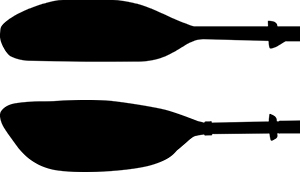
Symmetrical Blade vs. Asymmetrical Blade Example
Blade shape determines how much water the paddle moves and how evenly it moves it through the power phase of the stroke.
Symmetric blades are the same shape on both sides of the center spine. They work correctly when used with a high, nearly vertical stroke angle — when the blade enters and exits the water symmetrically, the equal-sided shape produces even force. Symmetric blades are common on entry-level recreational paddles and work fine for casual paddling where stroke technique isn’t a priority.
Asymmetric blades are cut shorter and narrower on the bottom edge of the blade. This compensates for the fact that most recreational paddlers use a low-angle stroke — the shaft held closer to horizontal rather than vertical. When a symmetric blade enters the water at a low angle, the top and bottom halves of the blade move through the water at slightly different depths, creating uneven force that wants to twist the blade sideways (called flutter). The asymmetric shape equalizes the surface area above and below the waterline at a low-angle entry, producing a cleaner, more stable pull. Most intermediate and above paddles use asymmetric blades because the majority of paddlers use a low-angle stroke for efficiency on long distances.
The Dihedral Ridge
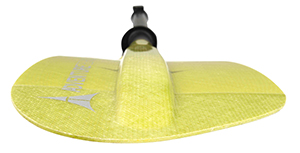
Dihedral Ridge Example
The dihedral is a raised rib running down the center of the blade face. It is one of the most functionally important features on a quality paddle blade and is worth understanding before buying.
When a flat blade moves through the water, water pressure builds against the face of the blade and looks for the path of least resistance — it tends to spill off one side or the other unpredictably. This side-to-side spillage is called flutter, and it manifests as a blade that constantly wants to twist in your hand during the stroke. Preventing flutter requires gripping the shaft more tightly, which causes hand fatigue; or correcting the twist with the wrist, which causes wrist fatigue. On a long paddle day, flat-blade flutter is a significant contributor to forearm and grip exhaustion.
The dihedral rib solves this by dividing the blade face into two equal angled panels that shed water symmetrically off each side. Water reaching the center rib is directed evenly left and right simultaneously, preventing the asymmetric pressure buildup that causes flutter. The result is a smooth, stable pull through the water where the blade tracks true without twisting, allowing a relaxed grip. The rib also stiffens the blade structurally, adding resistance to torsional flex that would otherwise waste stroke energy.
A flat blade without a dihedral moves more water per stroke but at the cost of flutter and grip load. This can be appropriate for sprint paddling or certain surf kayak applications where raw power matters more than sustained efficiency, but for recreational and touring use the dihedral blade is consistently more comfortable over distance.
Blade Material
Blade material affects stiffness, weight, durability, and price. From most affordable to most performance-oriented:
- Reinforced nylon (plastic): The most durable and impact-resistant blade material, and the most affordable. Nylon blades can take a beating on rocks, gravel bars, and shallow water without cracking. The downside is flex — a nylon blade flexes during the power phase of the stroke, which means some of your stroke energy goes into deforming the blade rather than moving water. For casual recreational use this is unimportant, but on a long-distance paddle the cumulative energy loss is real. Nylon is the right choice for anyone paddling rocky rivers, tidal flats, or other environments where blade impacts are frequent.
- Fiberglass blades: Significantly stiffer than nylon, which means better energy transfer per stroke. Fiberglass blades are lighter than nylon and have a refined flex profile that provides some natural feel without the energy-wasting flex of plastic. They are the standard blade material for intermediate to serious recreational and touring paddlers. They are less impact-resistant than nylon — a hard contact with a submerged rock can chip or crack a fiberglass blade.
- Carbon composite blades: The stiffest and lightest blade material available. Carbon blades have essentially zero flex, meaning every ounce of force applied to the shaft goes directly into moving the kayak. For touring paddlers covering long distances or racing, the efficiency difference between carbon and fiberglass blades becomes meaningful over many miles. Carbon blades are the most expensive and least impact-resistant — they should not be used in rocky whitewater or shallow gravelly environments where regular impact is expected.
- Wood blades: Traditional and beautiful. Wood blades have a natural stiffness profile that many experienced paddlers prefer for the feel of the stroke, and they are warm to the touch in cold conditions. Wood paddles require more maintenance (periodic varnishing or oiling) but are extremely durable when cared for and can last decades.
Stroke Style: High Angle vs. Low Angle
The angle at which you hold the shaft during the stroke has a significant effect on which paddle design works best for you. This is worth understanding because most first-time buyers choose a paddle without knowing their natural stroke style, then wonder why it doesn’t feel quite right.
Low-angle paddling is the most common recreational style. The shaft is held closer to horizontal — roughly 30–45° from the water surface — with the blade entering the water well out to the side of the kayak. This style is efficient for covering distance at a relaxed pace because the shoulder muscles stay lower and more relaxed, and it’s less tiring over hours on the water. Low-angle paddling works best with a longer shaft, a larger blade with an asymmetric shape, and a lower-angle blade face designed to enter the water efficiently at that angle. Most recreational and touring paddles are designed for low-angle use.
High-angle paddling holds the shaft more vertically — 60–80° from horizontal — with the blade entering the water close to the kayak’s side and driving through in a shorter, more powerful arc. High-angle paddling generates more power per stroke and provides better maneuverability, making it the preferred style for whitewater kayaking, surf kayaking, and anyone who prioritizes speed and control over all-day endurance. High-angle style uses a shorter shaft and a wider, shorter blade that works efficiently at a steep entry angle. The wider blade moves more water per stroke but requires more effort per stroke, which is appropriate for the high-intensity, shorter-duration paddling common in moving water.
If you are primarily paddling flatwater lakes, bays, and coastal areas for recreation and fitness, low-angle is almost certainly your natural style and you should choose accordingly. If you are paddling rivers, surf zones, or want maximum speed and agility, high-angle with a purpose-designed shorter blade is the better fit.
Specialty Paddles: Fishing and Touring
Angler-specific kayak paddles include several features designed for fishing use. The most practical is a notch cut into the blade edge for rescuing fishing line that gets caught in overhanging vegetation — hooking the notch around the line and pulling allows you to clear it without leaning out of the kayak and risking a capsize. Angler paddles are also typically designed with a quiet entry into the water to minimize splash noise that can spook fish, and they often use a drip guard design that keeps water off the line and gear on deck. Blade colors in green, blue, or dark patterns help the kayak blend into the environment rather than advertising your presence to nearby fish.

Angler Blade Notch Example
Touring paddle visibility: For sea kayaking and coastal touring where you may be paddling in boat traffic, in fog, or in low-visibility conditions, high-visibility blade colors — orange and yellow — make you significantly more visible to other boaters. A bright blade moving in the water catches attention more effectively than the kayak hull itself, which rides low and is easily missed. For any paddling in areas with motorized boat traffic, a high-visibility blade is a legitimate safety consideration, not just an aesthetic choice.
Related
Kayak Paddle FAQ
Paddle length is determined by both your height and your kayak’s width. A paddler under 5’4” on a typical recreational kayak (24–28” wide) will generally use a 215–220cm paddle. A paddler between 5’4” and 6’ on the same kayak will use 220–230cm. Taller paddlers over 6’ need 230–250cm. The wider your kayak, the longer the paddle you need — add approximately 10cm for a very wide kayak (over 30”) compared to a narrow sea kayak of the same paddler height. The key test: with the blade in the water, your knuckles should not hit the deck of the kayak on the stroke.
Feathering is the angular offset between the two paddle blades, typically adjustable from 0° to 60°. An un-feathered (0°) paddle has both blades in the same plane. A feathered paddle rotates one blade relative to the other so the out-of-water (recovery) blade slices edge-on through headwinds rather than catching them flat, reducing drag. The tradeoff is that feathering requires a slight wrist rotation with each stroke to keep the power blade square. For calm-water recreational paddling, 0° is simpler and perfectly comfortable. For coastal touring or exposed water where headwinds are common, 45° feathering is worth learning.
Low-angle paddles have a longer shaft, wider blade, and are designed for the shaft-near-horizontal stroke style used by most recreational and touring paddlers. This style is more efficient for covering long distances at a relaxed pace with less shoulder fatigue. High-angle paddles have a shorter shaft and shorter, wider blade designed for a more vertical stroke that delivers more power and better maneuverability — the preferred style for whitewater, surf kayaking, and speed-focused paddling. If you paddle flatwater lakes and bays for recreation, low-angle is almost certainly the right choice.
For paddlers who go out once in a while for a few hours, the difference between an aluminum/nylon paddle and a carbon paddle is noticeable but not critical. For anyone paddling regularly, covering significant distances, paddling multiple days in a row, or dealing with shoulder or joint issues, the weight reduction of carbon (typically 18–22 oz. versus 35–45 oz. for aluminum) translates directly into less fatigue across thousands of strokes. The efficiency gain from a stiffer blade also matters on long distances. If you paddle more than 20–30 days per year, carbon is worth the investment.
The dihedral is a raised rib running down the center of the blade face. It prevents flutter — the side-to-side twisting of the blade during the stroke — by dividing the blade face into two angled panels that shed water symmetrically to each side. Without a dihedral, water pressure builds unevenly against a flat blade and causes it to twist, which requires you to grip harder and correct with your wrist, causing hand and forearm fatigue. A dihedral blade tracks straight and true through the water with a relaxed grip, and the rib also stiffens the blade against torsional flex that would otherwise waste stroke energy.