
What to Consider When Choosing a Trolling Motor
Choosing the right trolling motor affects every aspect of boat control, from quietly approaching shallow-water fish to holding position in current, wind, or tidal flow. While many anglers focus solely on thrust ratings, the best trolling motor setup depends on multiple factors including boat weight, shaft length, battery capacity, operating environment, and advanced positioning features.
A trolling motor that is undersized may struggle to maintain boat position, drain batteries quickly, and reduce fishing efficiency. A properly sized trolling motor provides better control, longer runtime, quieter operation, and improved performance in challenging conditions.
- Freshwater vs. Saltwater
- Shaft Length
- Thrust Requirements
- Matching Thrust to Boat Size
- Power Consumption & Battery Planning
- Advanced Features
- Trolling Motor Glossary
- FAQs
Understanding How Trolling Motors Work
A trolling motor is a low-speed electric propulsion system designed primarily for precise boat positioning and stealth. Unlike gasoline outboards that prioritize speed, trolling motors are built to provide controlled movement while minimizing noise, vibration, and disturbance to fish.
Modern trolling motors have evolved into sophisticated boat control systems capable of GPS anchoring, route recording, autopilot steering, contour following, fishfinder integration, and wireless operation.
For serious anglers, the trolling motor often becomes the most frequently used propulsion system on the boat.
Bow-Mount Motors
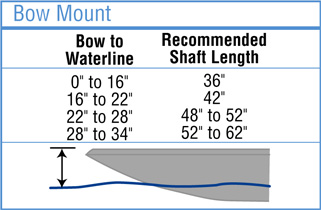
Add additional shaft length when regularly fishing rough water, tidal areas, large reservoirs, or open bays.
Bow-mounted trolling motors provide the highest level of boat control because they pull the boat rather than push it. Pulling allows more precise steering corrections and faster directional changes, which is particularly important when fishing docks, grass lines, riprap, bridge pilings, reefs, brush piles, and offshore structure.
Bow-mounted systems dominate bass fishing, walleye fishing, inshore fishing, and tournament angling because they allow anglers to maintain casting angles while keeping hands free for fishing.
Benefits of Bow-Mount Trolling Motors
- Superior boat control in wind and current
- Better tracking along shorelines and weed edges
- Compatible with GPS anchoring systems
- Available with foot pedal and wireless control
- Excellent for structure fishing
- Ideal for tournament anglers
Transom-Mount Motors
Transom-mounted trolling motors remain the most popular choice for small boats, jon boats, canoes, inflatables, dinghies, and kayaks. Their simple installation, lower cost, and portability make them attractive for casual anglers and boaters who need auxiliary electric propulsion.
Although they do not offer the same level of boat positioning precision as bow-mounted motors, they provide dependable slow-speed maneuvering and trolling capabilities.
Freshwater vs. Saltwater Trolling Motors
One of the first decisions involves selecting a trolling motor designed for the environment where it will operate.
Freshwater Trolling Motors
Freshwater models are designed for lakes, rivers, reservoirs, and inland waterways where corrosion is less aggressive. They generally cost less and offer excellent performance when used in their intended environment.
Saltwater Trolling Motors
Saltwater-rated trolling motors utilize:
- Corrosion-resistant alloys
- Sealed electronics
- Marine-grade coatings
- Stainless steel hardware
- Enhanced waterproofing
If you regularly fish coastal bays, flats, estuaries, tidal rivers, or nearshore waters, a saltwater-rated trolling motor is strongly recommended.
Shaft Length: The Most Common Sizing Mistake
Even the most powerful trolling motor performs poorly if the shaft length is incorrect.
The propeller should generally operate approximately 12" to 18" below the water's surface under normal conditions. When the shaft is too short, the propeller can ventilate and lose efficiency whenever the boat encounters waves, wakes, or wind chop.
Why Longer Is Usually Better
Many anglers underestimate shaft length requirements. A motor that appears adequately submerged at the dock may repeatedly break the surface when fishing rough water.
This causes:
- Propeller cavitation
- Reduced thrust
- Excess battery drain
- Poor GPS anchor performance
- Inconsistent steering control
If your measurements fall between recommended shaft lengths, choose the longer option.
Understanding Thrust Ratings
Trolling motors are measured in pounds of thrust rather than horsepower. Thrust represents the pulling force generated by the motor.
While horsepower and thrust are not directly interchangeable, anglers often use a rough comparison of:
72–75 pounds of thrust ≈ 1 horsepower
Typical Voltage and Thrust Ranges
- 12V Systems: 30–55 lb. thrust
- 24V Systems: 70–90 lb. thrust
- 36V Systems: 100–120+ lb. thrust
Higher voltage systems are generally more efficient because they produce greater thrust while drawing less current for the same level of performance.
Matching Trolling Motor Size to Boat Weight
Boat weight is far more important than boat length when sizing a trolling motor.
Total operating weight includes:
- Hull weight
- Passengers
- Fuel
- Batteries
- Tackle
- Coolers
- Livewell water
- Safety gear
- Electronics
General Thrust Guidelines
- Up to 1,500 lbs. = 40–55 lb. thrust
- 1,500–3,000 lbs. = 70–80 lb. thrust
- 3,000–5,000 lbs. = 80–112 lb. thrust
- Over 5,000 lbs. = 100+ lb. thrust
A commonly used rule recommends approximately 5 pounds of thrust for every 200 pounds of loaded boat weight. However, this should be considered a minimum baseline rather than a target.
Factors That Increase Thrust Requirements
- Strong tidal current
- Wind exposure
- Large open reservoirs
- High-sided boats
- Pontoon boats
- Heavy fishing loads
- Offshore structure fishing
Power Consumption & Battery Planning
Battery planning is just as important as selecting the motor itself.
Many anglers mistakenly purchase a large trolling motor but fail to provide adequate battery capacity.
Battery Runtime Formula
Battery Runtime = Battery Amp Hours ÷ Motor Amp Draw
Example:
- 100Ah battery
- 20A motor draw
- Approximately 5 hours runtime
Real-world runtime varies significantly based on:
- Wind conditions
- Current strength
- GPS anchor usage
- Boat weight
- Motor speed setting
- Battery condition
Lithium vs. AGM Batteries
Modern lithium marine batteries have become increasingly popular because they provide:
- Reduced weight
- Greater usable capacity
- Faster charging
- Longer lifespan
- Consistent voltage delivery
For anglers who spend long days on the water, lithium systems can significantly improve overall trolling motor performance.
Advanced Features Worth Considering
GPS Anchor Systems
GPS anchoring systems such as Spot-Lock allow the motor to automatically maintain position without deploying a traditional anchor. This feature has fundamentally changed how many anglers fish offshore structure.
Route Recording
Route recording allows anglers to save productive trolling paths and automatically repeat them later.
Contour Following
When integrated with compatible mapping systems, certain trolling motors can automatically follow depth contours.
Fishfinder Integration
Many premium trolling motors integrate directly with sonar and chartplotter systems to provide enhanced navigation and fishing functionality.
Brushless Motors
Brushless trolling motors offer:
- Improved efficiency
- Longer runtime
- Reduced maintenance
- Lower operating noise
- Higher reliability
Trolling Motor Glossary
Thrust: The pulling force generated by a trolling motor, measured in pounds.
Shaft Length: Distance from the motor mount to the propeller assembly.
GPS Anchor: Electronic system that automatically maintains boat position.
Spot-Lock: Minn Kota's GPS anchoring technology.
Amp Draw: Amount of electrical current consumed by the motor.
Battery Capacity: Total stored electrical energy measured in amp-hours (Ah).
Brushless Motor: Electric motor design that eliminates traditional brushes for greater efficiency and reliability.
Cavitation: Loss of propeller efficiency caused by air entering the propeller stream.
Contour Following: Automated tracking of underwater depth contours using electronic charts.
Bow Mount: Trolling motor installed at the front of the boat.
Transom Mount: Trolling motor installed at the stern of the boat.
Frequently Asked Questions
Is it better to have too much thrust or too little?
More thrust is generally preferable. A larger motor can operate at lower power settings while maintaining boat control, which often improves battery efficiency and handling in wind or current.
Do I need a 24V trolling motor?
Most boats larger than 16 feet or regularly operated in wind, current, or open water benefit significantly from a 24V system.
Can a trolling motor replace my outboard?
Trolling motors are designed for low-speed operation and boat positioning. While they can serve as auxiliary propulsion, they are not intended to replace primary outboard engines.
How much shaft length is too much?
A slightly longer shaft rarely causes problems. A shaft that is too short creates significant performance issues, making longer the safer choice when between sizes.
Are GPS trolling motors worth the extra cost?
For anglers who regularly fish structure, offshore reefs, bridge pilings, docks, current seams, or windy shorelines, GPS anchoring and route control features can dramatically improve fishing efficiency.