When you’re beyond cell phone range — offshore, in a remote anchorage, crossing a shipping lane at night — a satellite communication device is the link between you and help. Understanding the three main categories and how current devices compare helps you choose the right tool for how you actually boat.
- The Three Types: SEND, EPIRB, PLB
- Satellite Networks: Iridium vs. Globalstar
- SEND Device Comparison: SPOT vs. Garmin inReach
- EPIRBs in Detail
- PLBs in Detail
- Which Device Is Right for You?
- FAQs
The Three Types: SEND, EPIRB, and PLB
These three device categories serve overlapping but distinct purposes. Choosing the wrong one — or assuming one covers all your needs — is a common mistake.
| Device | Primary Use | Network | Subscription | Two-Way | Registration |
|---|---|---|---|---|---|
| SEND | Check-ins, tracking, emergency messaging | Commercial (Iridium or Globalstar) | Required | Yes (most models) | Manufacturer account |
| EPIRB | Emergency only — vessel distress | Cospas-Sarsat (free) | None | No | USCG NOAA (required by law) |
| PLB | Emergency only — personal distress | Cospas-Sarsat (free) | None | No | NOAA (required by law) |
Satellite Emergency Notification Devices (SEND) use commercial satellite networks to transmit GPS location, check-in messages, tracking breadcrumbs, and — on most current models — two-way text messages. They also include an SOS function that alerts a private emergency response coordination center (such as GEOS). SENDs require a subscription plan ranging from roughly $15 to $65 per month depending on features. They are the most versatile category and the best fit for boaters who want regular communication capability alongside emergency function.
Emergency Position Indicating Radio Beacons (EPIRBs) are vessel-registered distress beacons that transmit a distress signal over the international Cospas-Sarsat satellite system — free to use, no subscription. When activated, they alert the U.S. Coast Guard or appropriate maritime rescue authority with your vessel identity and GPS position. EPIRBs are emergency-only devices: they cannot send check-in messages, track your location for friends, or communicate two-way. They are, however, the gold standard for vessel distress signaling in offshore and coastal waters.
Personal Locator Beacons (PLBs) operate on the same Cospas-Sarsat system as EPIRBs but are registered to an individual rather than a vessel, making them portable across multiple boats. They are smaller than EPIRBs because they’re designed to be carried on your person. PLBs require a deliberate three-stage activation sequence to prevent false alarms — automatic activation is prohibited by FCC regulations. No subscription required.
Satellite Networks: Iridium vs. Globalstar
For SEND devices, the underlying satellite network matters more than most buyers realize.
Iridium uses a constellation of 66 low-Earth orbit satellites that provide genuinely seamless global coverage — including the poles. Every point on Earth has multiple Iridium satellites overhead at all times. Garmin inReach devices use Iridium.
Globalstar uses a different LEO constellation with coverage across most continental land masses and coastal areas, but with meaningful gaps in parts of the Southern Ocean, polar regions, and some offshore zones. SPOT devices use Globalstar. For most recreational boating in US coastal waters, Globalstar coverage is adequate. For offshore passages to remote areas, Iridium’s seamless global coverage is a meaningful advantage.
Check the current coverage maps at findmespot.com and Garmin’s inReach page before purchasing if you travel in areas where coverage gaps could matter.
SEND Device Comparison: SPOT vs. Garmin inReach
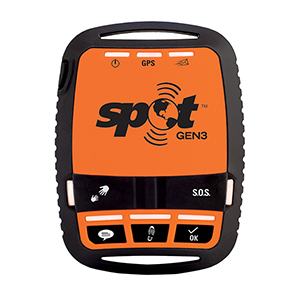
SPOT Gen4 Satellite Messenger — one-way GPS tracking, pre-set messages, and SOS. Entry-level SEND at approximately $149.99 plus subscription.
SPOT Devices
SPOT’s current lineup runs from the Gen4 (one-way) to the SPOT X with Bluetooth (two-way). Key distinctions:
SPOT Gen4 (~$149.99) is a one-way device: it transmits your location and pre-configured messages (OK, HELP, SOS) to your contacts and an emergency monitoring center, but it cannot receive replies. Subscription plans start around $17.95/month. It’s the lowest-cost entry into satellite communication and appropriate for boaters who primarily want GPS tracking and a reliable SOS function without two-way messaging. The fundamental limitation is that when you trigger SOS, you cannot communicate back with the rescue coordination center — you send the alert and wait.
SPOT X with Bluetooth adds a physical QWERTY keyboard and two-way messaging with any cell number or email address via the Globalstar network. It’s a larger device than the Gen4, with a 2.7” color screen. Bluetooth connectivity allows pairing with a smartphone for messaging from your phone rather than the keyboard. A dedicated US mobile number means contacts can reach you as if texting a phone.
SPOT subscription plans vary in message allocation and tracking intervals. Check current pricing directly at findmespot.com — plan structures change and the monthly cost is a meaningful part of the total ownership cost over time.
Garmin inReach Devices
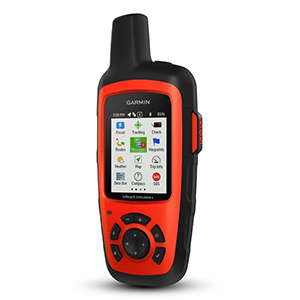
Garmin inReach Mini 2 — two-way messaging via Iridium global network. Pairs with your smartphone via Bluetooth and the Garmin Explore app.
Garmin’s inReach line runs on the Iridium network and offers full two-way messaging regardless of where you are on Earth. Current models include the inReach Mini 2 and the inReach Messenger.
Garmin inReach Mini 2 is the most popular SEND device for recreational users — compact (under 4 oz), two-way capable, and designed to pair with your smartphone via Bluetooth and the Garmin Explore app. You send and receive messages from your phone rather than a small screen. It includes real-time weather forecasts, waypoints, routes, and NOAA chart access through the Explore app. When you trigger SOS, a two-way connection opens with the GEOS Emergency Response Coordination Center, allowing you to communicate the nature of the emergency and receive confirmation. Garmin restructured its subscription plans in 2025; current plans start at approximately $14.99/month for SOS-only coverage with messaging tiers above that. Check Garmin’s inReach page for current plan pricing before purchasing.
Garmin inReach Messenger is a larger device with a built-in screen for messaging without a paired phone, making it better suited to users who want standalone operation rather than phone-dependent messaging.
Navigation features: Both current Garmin inReach models support waypoints, routes, and real-time weather via the Explore app. Downloaded NOAA charts and topographic maps are available on the phone through the app, with the inReach device providing the satellite connection for real-time data.
SPOT vs. Garmin inReach: Head-to-Head
| Feature | SPOT Gen4 | SPOT X (Bluetooth) | Garmin inReach Mini 2 |
|---|---|---|---|
| Network | Globalstar | Globalstar | Iridium (global) |
| Two-way messaging | No | Yes | Yes |
| SOS confirmation | No | Yes | Yes, two-way with GEOS |
| Phone pairing | No | Bluetooth | Bluetooth (primary interface) |
| Physical keyboard | No | Yes | No (phone keyboard via app) |
| Weather forecasts | No | No | Yes (via Explore app) |
| NOAA charts | No | No | Yes (via Explore app) |
| Device weight | ~4.4 oz | ~7.3 oz | ~3.5 oz |
| Starting device price | ~$149 | ~$200 | ~$350 |
| Starting subscription | ~$17.95/mo | ~$17.95/mo | ~$14.99/mo |
Prices and plans change frequently. Verify current pricing with the manufacturer before purchasing.
EPIRBs in Detail
An EPIRB is the most direct connection between a vessel in distress and maritime search and rescue. When activated, it broadcasts a 406 MHz distress signal over the Cospas-Sarsat satellite system, which is monitored by NOAA and the Coast Guard. The signal includes your vessel’s registered identity and GPS position, allowing SAR teams to know exactly what vessel they’re looking for and where before they launch.
Registration is required by law. All 406 MHz EPIRBs must be registered with NOAA at beaconregistration.noaa.gov. Unregistered EPIRBs generate significant SAR resources chasing down the vessel identity — and may result in a fine. Registration is free and takes about five minutes.
Hydrostatic release: Category I EPIRBs include a hydrostatic release unit (HRU) that automatically deploys and activates the EPIRB if the vessel sinks and the EPIRB is submerged to a depth of approximately 3–4 meters. Category II EPIRBs are manually activated only. For offshore and coastal passages where the vessel could sink rapidly, a Category I EPIRB with HRU is the appropriate choice.
Battery and service: EPIRBs have a battery life of approximately 5 years (or after any activation) and require a service date stamped on the unit. Most manufacturers recommend replacing the battery or the entire unit at the service date. Check your EPIRB’s service date before every offshore passage.
PLBs in Detail
A PLB is functionally similar to an EPIRB but registered to an individual rather than a vessel. This makes it the right choice for crew members who boat on multiple vessels, for single-handed sailors who want a personal beacon clipped to their life jacket, and for boaters who also use the device for hiking, hunting, or other remote activities.
PLBs use the Cospas-Sarsat system and require no subscription. They must be manually activated through a three-stage process (unscrew cap, deploy antenna, press and hold button) to prevent accidental activation — the FCC prohibits automatic activation on PLBs for this reason. Registration with NOAA is required, free, and must be renewed every two years.
PLBs are not a substitute for an EPIRB on offshore vessels. A PLB registered to a person tells SAR teams who you are but not what vessel you are on. An EPIRB registered to the vessel provides vessel identity, which is critical information for a coastal SAR response coordinating with vessel traffic data. Offshore passages should carry a vessel-registered EPIRB; PLBs are complementary for individual crew members, not a replacement.
Which Device Is Right for You?
A few scenarios to guide the decision:
Day sailing, coastal cruising, regular family outings in US waters: A SEND device (Garmin inReach Mini 2 or SPOT Gen4) provides check-ins, GPS tracking, and SOS function. This is sufficient for most recreational boaters who stay within the US coastal coverage zone and want family contact capability alongside emergency function.
Offshore passages, overnight runs, or operation beyond 20–30 miles: Carry both a SEND device and an EPIRB. The SEND provides two-way communication and daily check-ins; the EPIRB provides the formal vessel distress signal that activates the full maritime SAR system. USCG strongly recommends an EPIRB for any offshore operation.
Crew on multiple vessels, or boating plus land activities: A PLB registered to you personally is more flexible than a vessel-specific EPIRB and appropriate for crew who move between boats. Supplement with a SEND for communication capability.
Racing, ocean crossing, or extended offshore operation: All three — SEND for daily communication, EPIRB (Category I with HRU) for vessel distress, and PLBs for individual crew members to wear on their life jackets. This is the standard for serious offshore racing fleets.
Frequently Asked Questions
What is the difference between a SEND device and a PLB?
A SEND device uses commercial satellite networks (Iridium or Globalstar) to provide two-way messaging, GPS tracking, check-ins, and SOS function — but requires a monthly subscription. A PLB uses the government Cospas-Sarsat system (no subscription) to transmit a one-way emergency distress signal only — no check-ins, no tracking, no two-way messaging. A PLB is a lower-cost emergency-only device; a SEND is a communication device that also includes emergency function.
Do I need to register my EPIRB or PLB?
Yes — registration is legally required for all 406 MHz beacons in the United States. Register at beaconregistration.noaa.gov. For EPIRBs, registration is to your vessel. For PLBs, registration is to you personally. Registration is free, takes minutes, and must be updated if your vessel or contact information changes. An unregistered or incorrectly registered beacon wastes SAR resources and can result in a fine.
Is Garmin inReach better than SPOT?
For most boaters, yes — primarily because Garmin uses the Iridium satellite network, which provides genuinely global coverage including oceanic and polar areas where Globalstar (SPOT) has gaps. Garmin also offers two-way SOS communication with the GEOS Emergency Response Center, weather forecasts, and NOAA chart access via the Explore app. SPOT’s Gen4 is a more affordable entry point and adequate for US coastal boating where Globalstar coverage is solid, but the lack of two-way messaging on the Gen4 is a meaningful limitation in a true emergency.
Can a SEND device replace an EPIRB?
No — and they serve different purposes. A SEND routes your SOS through a private emergency response center (GEOS) which then contacts the Coast Guard or relevant authority. An EPIRB transmits directly to the Cospas-Sarsat system monitored by NOAA and the Coast Guard, with your vessel identity and GPS position immediately available to SAR coordinators. For offshore boating, carry both: the SEND for daily communication and early distress alerting, the EPIRB as the primary vessel distress signal.
How much does a Garmin inReach subscription cost?
Garmin restructured its subscription plans in 2025. Plans currently start at approximately $14.99/month for SOS-only coverage, with higher tiers for messaging and tracking. Check Garmin’s inReach subscription page directly for current pricing — plan structures change more frequently than hardware, and the monthly cost is a significant factor in the total ownership calculation over multiple years.
What is a hydrostatic release on an EPIRB?
A hydrostatic release unit (HRU) is a mechanism that automatically deploys and activates a Category I EPIRB if it is submerged to approximately 3–4 meters — meaning if the vessel sinks, the EPIRB floats free and activates without requiring anyone to manually trigger it. Category II EPIRBs require manual activation only. For any offshore or coastal passage where a vessel could sink rapidly, a Category I EPIRB with an HRU is strongly recommended. The HRU has a service life (typically 2 years) and must be replaced on schedule.