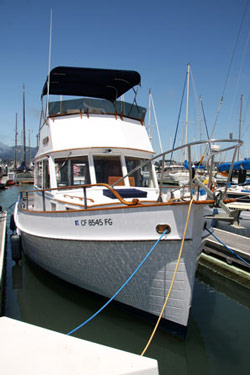
This 32' Grand Banks trawler has multiple fuel-burning devices that all need maintenance for safe operation. A CO detector is important insurance in case something goes wrong.
Carbon monoxide safety belongs on every boat owner’s maintenance checklist, especially on boats with cabins, generators, inboard engines, propane appliances, heaters or enclosed cockpit spaces. Carbon monoxide (CO) is invisible, odorless and tasteless, and symptoms can be mistaken for seasickness, dehydration or fatigue. That makes prevention, ventilation, mechanical inspection and properly installed carbon monoxide detectors the best defenses.
- The danger of carbon monoxide on boats
- Where CO collects on boats
- Symptoms of CO poisoning
- U.S. Coast Guard tips to avoid CO exposure
- Inspect your boat for CO hazards
- What to look for in CO detectors
- What to do if CO poisoning is suspected
- Carbon monoxide safety FAQ
The Danger of Carbon Monoxide on Boats
Carbon monoxide is produced whenever carbon-based fuels burn incompletely. On boats, the most common sources are gasoline or diesel engines, gas generators, cooking ranges, cabin heaters and other fuel-burning equipment. CO can build up inside cabins, partially enclosed cockpits, beneath canvas enclosures, near swim platforms, under hardtops and around stern areas where exhaust can linger.
The risk is not limited to the boat producing the exhaust. A boat idling nearby, a generator running on a rafted vessel, or exhaust drifting across a dock can create dangerous exposure aboard another boat. Downwind operation, following seas, canvas enclosures and poor ventilation can all increase risk by trapping or redirecting exhaust into occupied spaces.
A phenomenon known as the “station wagon effect” is one of the most dangerous and least understood CO hazards on powerboats. When a boat moves through the water, a low-pressure zone forms behind the transom. This zone can actively pull exhaust fumes forward rather than letting them disperse behind the vessel — drawing CO directly into the cockpit or cabin even when the boat is moving at cruising speed. The effect is most pronounced on trawlers, cruisers and boats with enclosed or partially enclosed cockpits, but it can occur on any vessel where the exhaust outlets are near an occupied area. Adding canvas enclosures, closing hatches on a hot day, or running slowly in a following sea all make the station wagon effect more likely to trap exhaust at dangerous concentrations.
CO is dangerous because it binds to hemoglobin in the bloodstream much more readily than oxygen — about 200 times more readily — reducing the blood’s ability to carry oxygen to tissues and organs. Early symptoms often look like ordinary boating discomfort: headache, dizziness, weakness, nausea, vomiting, chest pain or confusion. High exposure can cause unconsciousness, drowning or death. The insidious reality is that moderate exposure impairs judgment before it impairs consciousness, making victims less able to recognize the problem or take action. A person in a CO-exposed cabin may simply fall asleep without ever realizing they are in danger.
Where CO Collects on Boats
CO can collect anywhere exhaust is produced or trapped. The highest-risk areas are not always obvious, especially when air movement changes around a moving or docked boat. Understanding where CO accumulates is the first step toward preventing exposure.
- Cabins and sleeping spaces: Enclosed accommodation spaces can trap CO from engines, generators, heaters or nearby boats. CO at low concentrations accumulates slowly over hours — enough to cause symptoms in sleeping occupants who have no chance to notice them developing.
- Canvas-enclosed cockpits: Eisenglass, dodgers, biminis and full enclosures dramatically reduce ventilation and can allow exhaust to accumulate to dangerous levels quickly. A fully enclosed cockpit on a powerboat running a generator can reach hazardous CO concentrations within minutes if exhaust enters through any gap.
- Stern and swim platform areas: Exhaust collects around the transom, under swim platforms and behind the boat while the engine or generator is running. People swimming at the swim ladder, children playing on the platform or passengers sitting near the transom are at significant risk even though they are outdoors. This is one of the leading causes of CO fatalities on recreational boats.
- Raft-ups and docks: Exhaust from neighboring boats can enter your cabin or cockpit, especially when wind pushes fumes toward your boat. A generator running on the boat two slips down can create dangerous concentrations aboard your vessel if the wind is right — or wrong.
- Following seas or downwind running: The station wagon effect draws exhaust forward into the cockpit or cabin instead of dispersing it aft. Speed alone does not eliminate this risk — the boat’s aerodynamic profile, canvas configuration and sea state all affect where exhaust goes.
- Generator compartments: A leaking exhaust hose, failed clamp, cracked exhaust fitting or poor cooling-water flow can allow CO to seep into the bilge and migrate into the cabin. Generator exhaust problems are a leading cause of CO fatalities aboard boats because the generator is often running while everyone is asleep and the boat is fully enclosed.
Symptoms of CO Poisoning
The rate at which CO is absorbed into the bloodstream depends on the concentration in the air and the length of exposure. Symptoms can progress quickly, and people who are sleeping, intoxicated or already fatigued may not recognize early warning signs. The table below lists symptoms of CO poisoning by concentration — note how rapidly the progression from discomfort to death occurs at higher levels.
| 100 ppm | .01% | Slight headache in two to three hours |
| 200 ppm | .02% | Slight headache within two to three hours; loss of judgement |
| 400 ppm | .04% | Frontal headache within one to two hours |
| 800 ppm | .08% | Dizziness, nausea and convulsions within 45 minutes. Insensible in two hours. |
| 1,600 ppm | .16% | Headache, dizziness and nausea within 20 minutes. Death in less than two hours. |
| 3,200 ppm | .32% | Headache, dizziness and nausea in five to ten minutes. Death within 30 minutes. |
| 6,400 ppm | .64% | Headache and dizziness in one to two minutes. Death in less than 20 minutes. |
| 12,800 ppm | 1.28% | Death in less than three minutes. |
Two things make these numbers particularly alarming in a marine context. First, a malfunctioning generator or a boat with the station wagon effect operating can reach 800 ppm or higher in an enclosed cabin within minutes. Second, loss of judgment occurs before the onset of severe physical symptoms — at 200 ppm, a person’s ability to recognize danger and take action is already compromised. This is why CO detectors are not optional equipment on any boat with an enclosed space: by the time symptoms are obvious enough to prompt action, the ability to take that action may already be impaired.
If more than one person aboard develops headache, dizziness, nausea, weakness or confusion at the same time, assume CO exposure is possible until proven otherwise. Move everyone to fresh air immediately, shut down engines and generators if it is safe to do so, and seek emergency medical help.
U.S. Coast Guard’s Tips to Avoid CO Overexposure
- Operate combustion devices such as stoves, heaters and generators in well-ventilated areas. “Well-ventilated” means active airflow through the space, not simply having a hatch cracked. If you can’t feel air moving, assume it isn’t moving fast enough to clear exhaust.
- Supplement natural ventilation with fans or forced air. Keep forward-facing hatches open to allow fresh air circulation in accommodation spaces, even in inclement weather. A $30 bilge-style fan running in a cabin while the generator is on can make a meaningful difference in CO concentration.
- Close the hatches and set your course away from the path of exhaust fumes when motoring downwind in a following sea. The station wagon effect pulls exhaust forward — altering your heading by as little as 15 degrees can redirect exhaust away from occupied spaces.
- Install CO detectors in each cabin. It’s the most effective defense against a potentially fatal problem. A detector cannot prevent CO from forming, but it provides the warning that allows people to escape before they lose the ability to do so.
- Avoid any activity on the rear deck, swim platform, and around exhaust pipes while the engine or generator is running. This applies to children especially — the stern area is an instinctive gathering place on a docked or anchored boat, and it is exactly where exhaust concentrates.
- CO exposure danger also exists on deck, especially when a boat idles at the dock or seawall where exhaust can accumulate. Even when not running your engine, beware of CO accumulation from other boats that idle at the dock to windward. CO from a neighboring boat’s generator can reach harmful concentrations in your cockpit with no warning.
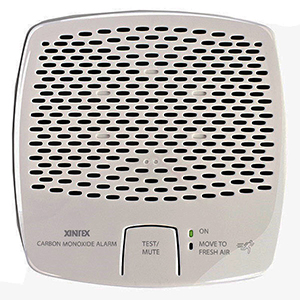
CO Detectors can be wired to your boat’s DC 12-volt system or are battery operated.
Inspect Your Boat for CO Hazards
Most CO problems on boats trace back to fuel-burning equipment, failed exhaust components, poor ventilation or operating habits that trap exhaust. A detector is important, but it is not a substitute for inspection and maintenance. A CO alarm that goes off is telling you something already failed. The inspection schedule below is designed to catch failures before they become emergencies.
Each Trip
Take the following actions whenever you use your boat. Do not operate the vessel if any of these problems exist. These checks take less than five minutes and address the failures most likely to cause CO exposure on any given outing.
- Know where your exhaust outlets are located. This sounds obvious but many boat owners cannot identify all of their exhaust exit points — especially on boats with both a main engine and a generator. Knowing the locations helps you understand where CO is produced and helps you brief passengers on areas to avoid.
- Brief all passengers on CO symptoms and risk areas before leaving the dock. Guests who do not know what CO poisoning feels like cannot report symptoms. A 30-second briefing — “if you get a headache or feel dizzy, tell me immediately” — has saved lives.
- When docked or rafted with another boat, be aware of their exhaust. Position your boat so that neighboring exhaust outlets point away from your cockpit and cabin openings. If a neighbor’s generator is running and wind is carrying exhaust toward you, consider relocating or closing the cabin.
- Confirm that cooling water flows from the wet exhaust outlet when the engine or generator is started. A wet exhaust system mixes cooling water with exhaust gases to cool them and reduce CO concentration near the outlet. If cooling water is not flowing, the exhaust system is operating hot and inefficiently — both a CO risk and a fire risk. If you do not see water within 30 seconds of starting a wet exhaust engine, shut it down immediately.
- Listen for any change in exhaust sound. A change in exhaust note — louder, rougher or with a different tone — can indicate a cracked exhaust component, loose clamp or failed water injection. These failures can dramatically increase CO production and allow exhaust to enter the boat.
- Test each CO detector by pressing the test button. The test button confirms the alarm circuit works but does not confirm the sensor is still sensitive. That is what the replacement date is for. If any detector fails to alarm during the test, replace it before getting underway.
- Check canvas, hatches and ventilation openings. Confirm that your enclosure arrangement is directing exhaust out rather than trapping it in. If you have made any changes to canvas, dodgers or bimini configuration since the last trip, reassess how ventilation is affected before running the engine or generator.
Once a Month
- Confirm all exhaust clamps are in place and secure. Hose clamps on exhaust connections are subject to heat cycling, corrosion and vibration. A clamp that was tight at installation may loosen over a season. Any loose clamp on an exhaust hose is a direct path for CO to enter the boat.
- Look for signs of exhaust leakage at all exhaust system connections and components. Signs include rust streaks, black soot marks, whitish salt deposits, water stains or any discoloration on hoses, fittings, bulkheads or engine compartment surfaces near exhaust components. Any of these is evidence that exhaust is escaping somewhere it should not be.
- Inspect rubber exhaust hoses for burned, cracked, soft or deteriorated sections. Run your hand along the length of accessible exhaust hoses. They should feel firm and pliable — not brittle, soft, collapsing or kinked. Kinks in exhaust hoses can cause backpressure that forces exhaust back into the engine compartment and the boat.
- Check generator sound shields and surrounding bulkheads for soot marks, water leaks or heat discoloration. Generators are often tucked into compartments where visual access is limited, which is exactly why regular inspection matters. Soot on a bulkhead near the generator exhaust connection is a serious warning sign.
Annually by a Qualified Marine Technician
- Replace exhaust hoses if any cracking, charring or deterioration is found. Marine exhaust hoses are not indefinite — heat, fuel vapors, ozone and vibration degrade them over time regardless of visual appearance. A hose that looks fine on the outside may be failing on the inside. Most marine technicians recommend replacement on a five- to seven-year cycle even if no obvious deterioration is visible.
- Ensure engines and generators are properly tuned. A poorly tuned engine produces significantly more CO than one running at its proper air-fuel ratio. If an engine runs rough, idles poorly or produces visible exhaust smoke, it is producing elevated CO and needs service before use.
- Inspect each water pump impeller and the pump housing condition. A failing impeller reduces cooling water flow to the exhaust system, which reduces the dilution of exhaust gases and allows the exhaust system to run hotter than designed. Replace impellers on the manufacturer’s recommended schedule, not just when failure is visible.
- Inspect all metallic exhaust components for cracks, rust, pitting, weeping or loose connections. Pay particular attention to the cylinder head, exhaust manifold and water injection elbow. The water injection elbow — the fitting where cooling water enters the exhaust stream — is one of the most common failure points on wet exhaust marine engines. A cracked or corroded elbow allows exhaust gases to escape before they are cooled and diluted.
- Inspect and test the generator cooling water anti-siphon valve if equipped. This valve prevents seawater from siphoning back into the generator when it is not running. A failed anti-siphon valve can cause water to flood the generator exhaust system, which can lead to hydrostatic lock and exhaust component damage that creates CO pathways into the boat.
- Confirm CO detectors are within their service life and replace any that have reached their printed replacement date. A CO detector that is past its service life may illuminate its power indicator and test normally while providing no actual detection capability. Service life is typically five to seven years from manufacture date, not installation date — check the label.
What to Look for in CO Detectors
Marine-rated certification: Use carbon monoxide detectors intended for marine use and tested to UL 2034 requirements for recreational boats. A household CO detector from a hardware store is not an acceptable substitute. Marine detectors are built to withstand the vibration of an engine running at 2,500 rpm, the humidity of an enclosed cabin in summer, the salt air corrosion of a coastal environment, and the temperature swings between a cold overnight anchorage and a hot August afternoon in the sun. Household detectors are not designed for any of these conditions and will fail prematurely in the marine environment — often without any visible indication that they have stopped working.
Time-weighted averaging: A marine carbon monoxide detector should compute the time-weighted average of CO concentration rather than alarming solely on instantaneous readings. This approach tracks cumulative exposure over time, which is how CO actually damages the body, and helps the detector distinguish between a brief spike from a passing exhaust puff and a sustained buildup that represents genuine danger. Time-weighted averaging reduces nuisance alarms from transient sources while ensuring the alarm sounds before occupants reach a medically significant exposure level.
Multi-channel monitoring: On boats with multiple sleeping compartments, a single detector in the main cabin is not sufficient. Multi-channel systems allow detectors to be linked so that when one alarm triggers, all units aboard alarm simultaneously. The Xintex CMD5-MD-R allows up to ten detectors to be linked together — when one detector’s alarm activates, all connected units alarm to alert everyone on the boat regardless of where they are sleeping. On a boat with a forward stateroom, an aft cabin and a salon, separate coverage in each space is essential.
Sensitivity and alarm thresholds: Marine CO alarms are calibrated to alarm based on both concentration and exposure time, following UL 2034 standards. A properly calibrated detector will not alarm at 35 ppm for a brief moment but will alarm if 70 ppm is sustained for four hours, or 150 ppm is present for 50 minutes — thresholds that reflect medically meaningful exposure. Understand your detector’s alarm logic and what its alarm means so you can respond appropriately.
Sensor mounting position: CO has nearly the same density as air and distributes relatively evenly throughout an enclosed space rather than pooling at floor level like propane. Install detectors following the manufacturer’s specific instructions for your unit — most marine CO detectors perform best when mounted at bunk or seated height in sleeping and accommodation spaces. Avoid locations near hatches, portholes, vents or any area where spray or condensation could contact the sensor.
Replacement date: CO detector electrochemical sensors have a finite service life — typically five to seven years — after which their sensitivity degrades regardless of whether they appear to function. Mark the installation date on the unit, follow the manufacturer’s replacement schedule and replace the detector by its printed replacement date even if the power light still illuminates and the test button still triggers the alarm. The test button verifies the alarm circuit, not the sensor’s chemical sensitivity.
What to Do if CO Poisoning Is Suspected
Do not wait for symptoms to become severe. If a CO alarm sounds, if passengers show symptoms, or if exhaust is suspected inside the boat, treat the situation as a serious safety event from the first moment. CO poisoning impairs the judgment needed to recognize CO poisoning — which means the window between “something feels off” and “unable to act” is shorter than most people realize.
- Move everyone to fresh air immediately. On a boat, “fresh air” means the open deck or dock, not a different cabin or the cockpit if it is enclosed. Get everyone as far from enclosed spaces and exhaust sources as possible. Do not stop to gather belongings.
- Shut down engines, generators, heaters and all combustion devices if it is safe to do so without re-entering the enclosed space. If the switches are on deck or at the helm station and accessible from outside the cabin, shut them down. If not, prioritize getting people into fresh air first.
- Open all hatches, ports and doors to ventilate the boat as rapidly as possible. CO disperses quickly once air movement is established — cross-ventilation through open hatches on both ends of the cabin is the fastest way to clear it.
- Account for all passengers, including anyone sleeping below. A person who has been exposed to CO for longer than those who were awake may be incapacitated. Do not assume that someone sleeping below is simply asleep.
- Call 911, hail the Coast Guard or seek emergency medical help if any symptoms are present — headache, nausea, confusion, weakness or loss of consciousness. CO poisoning requires medical evaluation even when symptoms seem mild. Carboxyhemoglobin levels in the blood can continue to cause harm after the exposure is removed, and hyperbaric oxygen treatment may be needed in serious cases.
- Do not re-enter enclosed spaces until the source has been identified, the boat has been thoroughly ventilated and the CO detector confirms safe air quality. Even if symptoms resolve quickly in fresh air, the source of CO is still present and will immediately begin to rebuild concentration when the cabin is reoccupied.
- Have all systems inspected before operating the boat again. Do not restart the engine, generator or any combustion device and do not allow overnight habitation until a qualified marine technician has identified and corrected the source of CO. Whatever failed once can fail again immediately.
More Information
For more about carbon monoxide poisoning and what you can do to prevent it, read Carbon Monoxide Poisoning a Dangerous Combination, which originally appeared in United States Coast Guard Boating Safety Circular 86.
Carbon Monoxide Safety FAQ
Any boat with an enclosed accommodation space should have marine-rated carbon monoxide detectors installed. Boats with cabins, sleeping spaces, inboard engines, generators, heaters, propane appliances or enclosed cockpits carry the highest risk. Open boats with outboard engines are lower risk but are not immune — even boats without generators can be exposed to CO from their own engine exhaust or from neighboring boats at a dock or raft-up. If people sleep aboard or spend time in enclosed spaces on your boat, a CO detector belongs there.
Install CO detectors in every enclosed accommodation space and sleeping area, following the detector manufacturer’s mounting instructions. CO distributes throughout a space similarly to air, so detectors should be mounted at approximately bunk or seated height rather than at floor level. Avoid placing them near hatches, portholes, ventilation intakes or any area where spray, rain or condensation could contact the sensor. A single detector in the main salon is not adequate coverage for a boat with a separate forward stateroom, aft cabin or pilot berth — each enclosed sleeping space needs its own detector or a linked remote sensor.
Yes, and this is one of the most dangerous aspects of CO exposure on boats. Headache, dizziness, nausea, weakness and vomiting all overlap with seasickness, heat exhaustion and dehydration — conditions that are common on the water and that people tend to push through rather than treat as emergencies. The critical diagnostic distinction is that CO exposure affects multiple people at the same time, and symptoms improve when moving into fresh air. If more than one person feels ill simultaneously, or if symptoms ease after spending time on deck, treat CO exposure as a serious possibility and take immediate action.
No. The swim platform and stern area are among the highest-risk locations on a boat for CO exposure, precisely because they are outdoors and people do not expect the danger. Exhaust from the main engine and any generator exits near the transom and can collect under the swim platform, around the boarding ladder and in the immediate stern area at concentrations well above safe limits. Multiple CO fatalities have occurred involving children playing on swim platforms while the generator was running. Do not allow anyone to sit, stand, swim, board or play near the stern, swim platform or exhaust outlets while any engine or generator is in operation.
Replace CO detectors by the printed replacement date on the unit, which is typically five to seven years from the manufacture date. The electrochemical sensor inside a CO detector degrades over time regardless of use, and an expired sensor can illuminate its power light and respond to the test button while being unable to detect CO. Test detectors before each trip by pressing the test button. If a detector fails the test, replace it immediately — do not attempt to repair or reset it. Also replace any detector that has triggered a real alarm, as sustained exposure to CO can accelerate sensor degradation.