Understanding the difference between 12V and 24V marine electrical systems is essential for any boater planning an upgrade, refit, or new build. Whether you are dealing with voltage drop on long wire runs, sizing wire for a high-current windlass, or evaluating whether a dual-voltage boat wiring setup makes sense, this guide covers the key principles, ABYC standards, and trade-offs you need to know. For a complete overview of required safety equipment, see U.S. Coast Guard Required Safety Equipment for Recreational Vessels.
The limit of 12V marine electrical systems: voltage drop
Most boats under 40 feet that have an electrical system operate at a nominal voltage of 12 volts. They use a battery with a fully-charged potential of 12.6 volts, and the loads and charge devices installed on the boat are designed to operate between roughly 12 and 14 volts. This stems from boats having historically used automotive- and industrial-based components, which are also built around the 12-volt standard.
As boats get larger—say in the 50–60 foot range—and operate DC loads that require more power with wire runs getting longer, 12-volt systems start to become inadequate. It becomes increasingly difficult to avoid voltage drop—the primary nemesis of boat wiring systems—which causes electrical devices to function below their rated efficiency. Voltage drop occurs due to electrical resistance in wires, connectors, switches, and other conductors in the circuit. No component is immune, but voltage drop can be measured and managed. A correctly-engineered vessel will not suffer from it.
For example, consider a simple circuit with a battery, bilge pump, wires, and a switch. A bilge pump uses a DC motor that consumes a certain amount of power quantified in watts; in this case, assume the pump consumes 60 watts. In a 12-volt electrical system, this pump draws 60 watts ÷ 12 volts = 5 amperes.
The American Boat and Yacht Council (ABYC) Standard E-11 recommends no more than a 3 percent voltage drop for this type of circuit and directs the installer to Table X, where the recommended wire size can be determined based on current and circuit length. For a 50-foot boat with a 30-foot total round-trip wire run at 5 amps, ABYC Table X recommends 12-gauge wire to keep the voltage drop under 3 percent.
(As a brief aside, we can calculate the voltage drop directly: 12-gauge wire has a resistance of approximately 1.75 ohms per 1,000 feet, or 0.00175 ohms per foot. Applying V = I × R gives: V = 5A × (30′ × 0.00175) = 0.2625V, which is approximately 2.2% of the 12-volt nominal and therefore less than the 3% maximum.)

24V marine electrical system advantages
Now apply the same calculation to a 24-volt marine electrical system. The same 60-watt bilge pump draws only 2.5 amperes (60 ÷ 24), and a 3 percent allowable voltage drop equals 0.72 volts (24V × 0.03). Referring to the appropriate ABYC table for a 3% voltage drop, the recommended wire is as small as 16 gauge. (While 18 AWG wire meets the voltage drop equation mathematically, ABYC E-11 and USCG regulations specify that standalone conductors used in general boat wiring must be at least 16 AWG.)
The resulting smaller wire in a 24V system provides several measurable advantages:
- It is less expensive—using smaller conductors can substantially reduce wire cost, particularly on long, high-current runs.
- It is lighter, improving vessel efficiency and reducing displacement.
- It is smaller in diameter, making it easier to route through bulkheads, in conduit, and around tight corners.
Why not use 24V systems on all boats?
If 24V systems are so efficient, why do most boats continue to use 12V? The primary reason is product availability. The vast majority of marine electronics, pumps, inverters and chargers, and accessories are designed for 12V. Additionally, a 24V battery bank is commonly created by wiring two 12V batteries in series, although purpose-built 24V batteries are also available.
The advantages of smaller wire are also only meaningful when currents are large or wire runs are long. Small boats can use 16-gauge wire for most circuits and remain well within ABYC limits without any voltage drop issues.
A more fundamental constraint is the engine. The vast majority of pleasure boat engines are 12V-based, with 12V starters, alternators, instruments, and fuel injection systems. This makes eliminating a 12V system from a boat with a standard engine very difficult. If the engine has a 12V starting system, it is generally more practical to retain a dedicated 12V starting circuit than to supply starter current through a DC-to-DC converter. When asked about dual-voltage configurations, one experienced cruising sailor and electrical engineer offered this perspective: “In my view, if a boat’s engine has a 12V system, it only makes sense to have a 24V house bank if the boat has very heavy electrical loads—windlass, canting keel pump, electric winches, and so on. If the heaviest loads are just refrigeration and a DC watermaker, the weight of the heavier wiring may be offset by avoiding a DC-to-DC converter and the simplicity of running a single voltage throughout.”
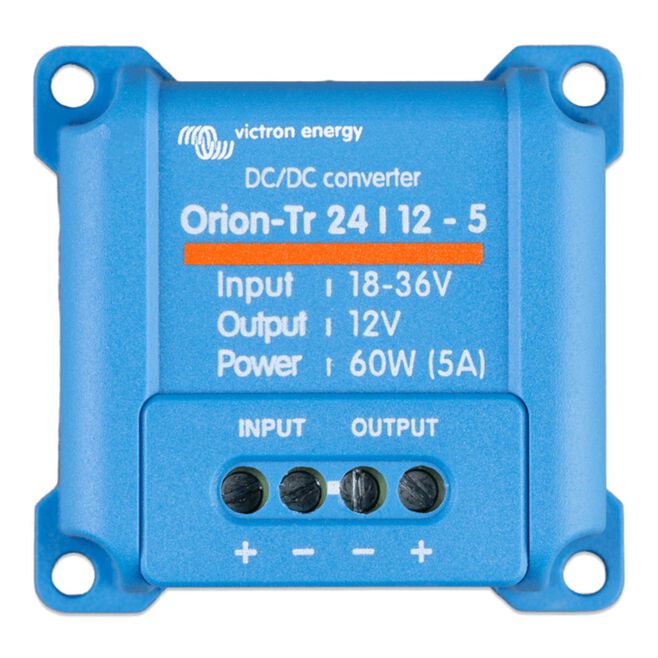
When 24V boat owners need to run 12V accessories, two approaches are available:
Use a 24V-to-12V DC converter to power 12V products. These range from small 10A devices for a single electronic item such as a VHF radio, to large 50–100A converters powering multiple systems throughout the vessel. For marine electronics and other noise-sensitive equipment, choose a DC-to-DC converter designed to minimize electromagnetic interference and rated for the marine environment.
Alternatively, install both a 12V and a 24V system. This requires appropriate battery banks, charging sources and distribution for each voltage; depending on the design, DC-to-DC converters can reduce the need for separate 12V charging and distribution equipment. It also introduces a potential redundancy risk: if one bank fails, systems dependent on that voltage lose power entirely.
Conclusion: choosing between 12V and 24V marine electrical systems
As diesel, gasoline, and copper prices rise, and as the demand for powerful electrical systems aboard grows, using a higher system voltage can deliver meaningful savings in wire cost and weight on larger vessels. While a 24V marine electrical system increases the complexity of your boat’s wiring, it enables DC loads that would otherwise be impractical to accommodate. Plan for redundancy in your design so that you can start your engine and operate 12V items if the 12V bank fails, while maintaining a solution for your 24V loads as well.
For help selecting the right wire, battery, or charging equipment, browse our full selection of marine wire and cable, battery chargers, and DC-to-DC converters.
Voltage drop and 24V system FAQ
Voltage drop refers to the loss of electrical potential as current flows through resistance in wires and connections. This reduces the power available to onboard devices, especially over long wire runs, and can cause equipment to perform below its rated capacity.
12V systems are standard because they are compatible with automotive and industrial components, require only a single battery, and offer a far wider range of available marine electronics and accessories than 24V systems.
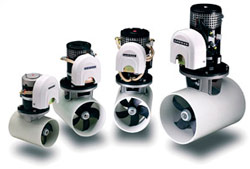
On larger boats—typically 50 feet and above—with high DC loads such as windlasses, bow thrusters, and large watermakers, combined with long wire runs, voltage drop becomes severe enough to make 12V wiring bulky, costly, and inefficient.
24V systems require smaller, lighter, and less expensive marine wire for equivalent power delivery, produce lower current draw (reducing heat and voltage drop), and enable more efficient operation of high-demand equipment.
Use the formula V = I × R, where I is current in amps and R is total resistance in ohms. Wire resistance is calculated based on gauge and total round-trip circuit length. The ABYC E-11 standard and Table X provide recommended wire gauges for given current and run lengths.
ABYC Standard E-11 recommends a maximum allowable voltage drop of 3% for critical equipment (such as navigation lights, bilge pumps, electronics, and main power feeders) and 10% for non-critical circuits (such as cabin lighting and general outlets).
Yes, but dual-voltage boats require separate battery banks, distribution panels, and often dual alternators. A DC-to-DC converter can step 24V down to 12V to power 12V accessories. This adds complexity and may reduce redundancy if one bank fails.
A DC-to-DC converter safely steps 24V down to 12V to power 12V devices from a 24V house bank. Units range from small 10A converters for single electronics to large 50–100A converters powering multiple systems. For marine electronics and other noise-sensitive equipment, choose a DC-to-DC converter designed to minimize electromagnetic interference and rated for the marine environment.