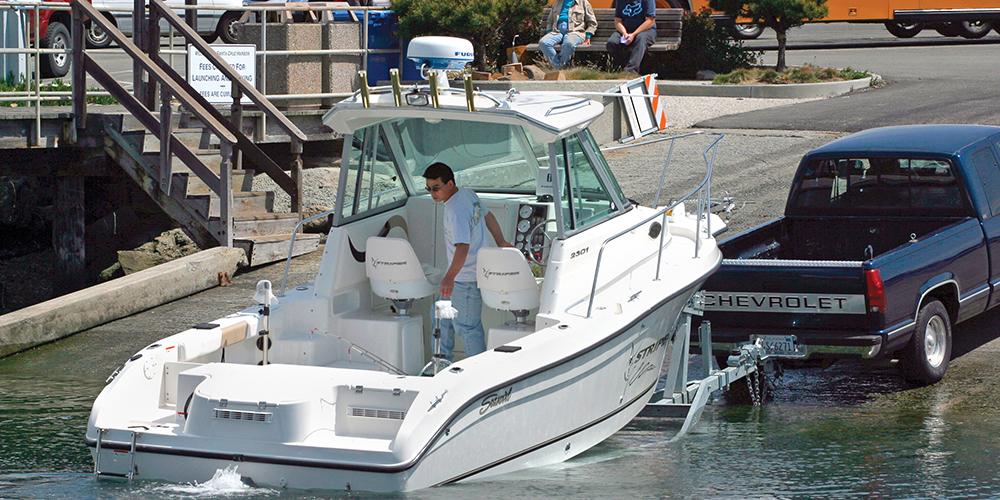
The following quiz covers 20 of the most common missteps boaters make at the ramp — before launch, during launch, and at retrieval — along with the exact steps to avoid each one. New to trailering? Start by reading our West Advisor article Boat Trailering Basics first, then work through this checklist before your first ramp visit.
- Question 1: Most common pre-launch mistake
- Question 2: Backing up a trailer
- Question 3: Why to prep before the ramp
- Question 4: Forgetting the bow line
- Question 5: Engine mistake during launch
- Question 6: Pressure at busy ramps
- Question 7: Transom straps left on
- Question 8: Blocking the ramp after launch
- Question 9: Raising the engine
- Question 10: Launching at night
- Question 11: Avoiding the rush
- Question 12: Emergency brake and wheel chocks
- Question 13: Trimming the engine on retrieval
- Question 14: Driving onto the trailer
- Question 15: Cinching the winch strap
- Question 16: Trailer backed too deep
- Question 17: Winch security before retrieval
- Question 18: Bimini top at the ramp
- Question 19: Rinsing after saltwater use
- Question 20: Post-retrieval draining
- Boat Launch Mistakes — Frequently Asked Questions
- Related Articles
- Related Shopping Links
Question 1: What is the most common mistake boaters make before launching their boat?
- A) Forgetting to charge the battery
- B) Leaving the boat's cover on
- C) Forgetting to replace the transom plug
- D) Not checking fuel levels
Correct Answer: C) Forgetting to replace the transom plug
Forgetting the transom plug is one of the most common — and potentially disastrous — mistakes at the ramp. The plug prevents water from entering the hull through the drain hole. Without it, water floods in the moment the boat enters the water, forcing a panicked scramble back onto the trailer. In extreme cases it can sink the boat.
How to avoid it: Make it the first item on your launch checklist.
Question 2: What is a common problem when backing up a trailer for launch?
- A) Misjudging the trailer's position
- B) Forgetting to turn off the lights
- C) Having passengers in the boat
- D) Overloading the boat
Correct Answer: A) Misjudging the trailer's position
Backing a trailer is counterintuitive: the wheel turns opposite to the direction you want the trailer to go. Under the pressure of a busy ramp, over-corrections lead to jackknifing, submerging too deep, or clipping the dock. Misjudging position is the root cause of most ramp delays and minor accidents.
How to avoid it: Before heading to a busy ramp, practice in an empty parking lot. Use your side mirrors and backup camera, make small steering inputs, and move slowly. At the ramp, ignore the queue behind you — one calm launch beats three panicked ones. For a deeper walkthrough, see our West Advisor article DIY: Safe and Trouble-Free Trailering.
Question 3: Why is it important to prepare the boat before arriving at the ramp?
- A) It helps organize your gear
- B) It prevents blocking the ramp
- C) It makes the launch faster
- D) All of the above
Correct Answer: D) All of the above
Arriving unprepared forces you to load gear, remove straps, and brief your crew while blocking the ramp — the single biggest source of congestion on busy weekends. Preparing ahead organizes your gear, keeps the ramp clear for others, and makes your launch faster.
How to avoid it: Use the staging area (the parking lot before the ramp) for everything: load coolers and safety gear, loosen or remove straps, assign crew duties. You should reach the ramp ready to launch in under two minutes. Use our Do-It-Yourself Trailering Checklist to run through every step in order.
Question 4: What happens if you forget to secure the bow line before launching?
- A) The boat won't start
- B) The boat could drift away
- C) The boat will stay on the trailer
- D) The boat may capsize
Correct Answer: B) The boat could drift away
Once off the trailer, an unsecured boat is at the mercy of wind and current. Even a gentle breeze can push it away from the dock within seconds, risking a collision with other vessels or a difficult retrieval.
How to avoid it: Attach bow and stern lines before backing down the ramp. Hand them to a crew member on the dock the moment the boat floats free. Launching solo? Tie off to a dock cleat before unhooking from the winch strap.
Question 5: What mistake do new boaters make regarding the engine during launch?
- A) Starting the engine before the boat is in the water
- B) Forgetting to start the engine
- C) Leaving the engine running during launch
- D) Not checking the engine's oil
Correct Answer: A) Starting the engine before the boat is in the water
Outboard, inboard, and I/O engines draw raw water for cooling. Running any of them dry — even for two to three minutes — burns out the impeller, often requiring a costly rebuild. This is one of the most preventable and most expensive ramp mistakes.
How to avoid it: Make "engine off until afloat" a non-negotiable step. The boat must be fully in the water with the lower unit submerged before you start the engine. Add it to your launch routine and your pre-launch checklist.
Question 6: Why do boaters struggle with backing up trailers at busy ramps?
- A) Miscommunication with partners
- B) Lack of practice
- C) Not enough space at the ramp
- D) All of the above
Correct Answer: B) Lack of practice
Reverse trailer steering feels unnatural — your instincts work against you until the logic clicks through repetition. Add onlookers and a backed-up ramp, and anxiety amplifies every small error. Lack of practice is the root cause in the vast majority of cases.
How to avoid it: Spend 20 minutes in an empty parking lot with cones set up as a mock ramp lane before your first real launch. Make small, slow inputs. After 10–15 runs, reverse trailer steering becomes intuitive. See Boat Trailering Basics for a step-by-step breakdown of the technique.
Question 7: What happens if you leave the boat's transom straps on during launch?
- A) The boat floats away
- B) The boat won't come off the trailer
- C) The boat may flip over
- D) The boat will drift to the side
Correct Answer: B) The boat won't come off the trailer
Transom straps left on prevent the boat from sliding free, creating a chaotic situation at the bottom of the ramp. At worst, the trailer and boat float together as an uncontrolled unit, risking damage to the transom, bunks, and nearby vessels.
How to avoid it: Remove all rear straps in the staging area before joining the ramp queue. Only the bow winch strap stays on. This is one of the most commonly skipped steps on a pre-launch checklist — add it explicitly.
Question 8: What mistake do boaters make when parking after launching?
- A) Leaving the trailer in the water
- B) Blocking the ramp
- C) Forgetting to lock the vehicle
- D) Parking in a restricted zone
Correct Answer: B) Blocking the ramp
After the stress of launch, it's tempting to pause and gather yourself — but stopping on or near the ramp blocks everyone behind you. On a busy holiday weekend, this single mistake can back up a ramp for 30 minutes or more.
How to avoid it: Before launching, assign one crew member to pull the empty trailer to the parking area the instant the boat is free. Another crew member stays with the boat at the dock. Never stop partway up the ramp.
Question 9: Why is it important to raise the engine before launching?
- A) To reduce fuel consumption
- B) To avoid damage to the propeller
- C) To prevent the engine from overheating
- D) To increase speed
Correct Answer: B) To avoid damage to the propeller
With the engine in the down position, the prop and skeg are close to the ramp surface as the boat slides back. Contact with a concrete ramp — even briefly — can bend prop blades or snap the skeg, both of which are costly repairs.
How to avoid it: Trim the engine all the way up before backing down the ramp. Lower it to the running position only after the boat is fully floating clear of the trailer. This also applies in reverse on retrieval — see Question 13.
Question 10: What mistake can lead to problems when launching a boat at night?
- A) Rushing the process
- B) Launching without assistance
- C) Attempting the process without adequate illumination
- D) Texting while launching
Correct Answer: C) Attempting the process without adequate illumination
Depth judgment is difficult in daylight. In the dark, without proper lighting, it's nearly impossible to align trailer bunks correctly, judge where the ramp ends, or spot underwater obstacles. Nighttime ramp misalignment is a leading cause of trailer and hull damage.
How to avoid it: Install illuminated trailer guide posts — they give you visible reference points from the driver's seat in complete darkness. Scout the ramp layout during daylight before your first nighttime launch. Always carry a waterproof flashlight. For more on trailer accessories, see 5 Easy Upgrades for Your Trailer.
Question 11: What should you do to avoid rushing the launch?
- A) Skip the pre-launch checklist
- B) Launch as quickly as possible
- C) Wait for everyone else to go first
- D) Take your time and follow each step
Correct Answer: D) Take your time and follow each step
Rushing creates the very delays it tries to avoid. A forgotten transom plug or a jackknifed trailer caused by a panicked correction takes far longer to fix than the 60 seconds saved by skipping a checklist step. Slow is smooth. Smooth is fast.
How to avoid it: Stay calm, follow your checklist in order, and remember that the queue behind you would rather wait an extra minute for a methodical launch than 15 minutes while you fix a preventable mistake.
Question 12: What are two actions that must be taken after backing down a launch ramp?
- A) Turn off the radio
- B) Sound your horn
- C) Engage the emergency brake and place wheel chocks
- D) Kill the tow vehicle's engine
Correct Answer: C) Engage the emergency brake and place wheel chocks
A wet, sloped ramp combined with the weight of a loaded trailer creates real rollback risk, even with the transmission in park. The emergency brake alone may not hold on a steep or slippery surface. Wheel chocks behind the rear tires provide a physical stop independent of brake friction.
How to avoid it: Keep wheel chocks accessible — hanging from the trailer tongue or in a net behind the driver's seat. Setting them should be a reflex the moment the trailer is in position, before you step away from the vehicle. Include both steps in your launch day checklist.
Question 13: What can happen if you forget to trim the engine up before pulling the boat out of the water?
- A) The boat will go too fast
- B) The lower unit's skeg and/or propeller could scrape the ramp
- C) The boat won't stay on the trailer
- D) The boat may drift sideways
Correct Answer: B) The lower unit's skeg and/or propeller could scrape the ramp
Even a brief contact between the skeg and a concrete ramp can break it off entirely. Damaged skegs affect directional stability at low speeds. Prop blade contact with hard surfaces causes imbalance that often requires full prop replacement.
How to avoid it: Before signaling the driver to pull forward, trim the outboard or sterndrive all the way up and verify visually that it's fully raised. This 10-second check prevents repairs that can run into hundreds of dollars. See also Question 9 for the same step at launch.
Question 14: What mistake do boaters sometimes make when they drive the boat onto the trailer?
- A) Driving too slowly
- B) Not lining up the trailer properly
- C) Forgetting to adjust the winch
- D) Driving the boat too fast
Correct Answer: D) Driving the boat too fast
Driving onto the trailer too fast is a leading cause of bow damage, cracked gelcoat at the bow stop, bent trailer frames, and in serious cases, the bow jumping the trailer and striking the tow vehicle.
How to avoid it: Approach at idle or just above. You want just enough momentum to ride up onto the bunks smoothly — if you feel the impact when the bow hits the stop, you were going too fast. Cut throttle earlier and let the final few feet be pure momentum. For more on loading technique, see Boat Trailering Basics.
Question 15: Why is it important to cinch up on the winch strap?
- A) It ensures the boat is level
- B) It helps secure the boat to the trailer
- C) It keeps the engine in the right position
- D) It helps the boat steer better
Correct Answer: B) It helps secure the boat to the trailer
A slack winch strap allows the boat to shift or slide during transport, which can damage the hull or trailer and creates a safety hazard — especially when braking hard or cornering at highway speeds.
How to avoid it: After confirming the boat is centered on the trailer and the bow is seated against the bow stop, tighten the winch strap fully. Attach the safety chain to the bow eye and give the strap a final tug to confirm the ratchet is engaged. Never drive with a slack winch.
Question 16: What can happen if the trailer is backed too deep into the water?
- A) The boat may not come off the trailer
- B) The boat could float away
- C) The boat may float over the trailer
- D) The trailer could flip over
Correct Answer: C) The boat may float over the trailer
When the trailer is submerged too far, the boat floats over the bunks or rollers instead of resting on them. On retrieval this means the hull isn't properly supported — the boat can slide sideways or slam down onto the trailer as the vehicle pulls forward.
How to avoid it: Back in only deep enough so the stern just starts to float while the forward hull is still lightly supported by the bunks or rollers. Practice finding the correct depth at a quiet ramp before attempting it at a busy one. For trailer setup guidance, see 5 Easy Upgrades for Your Trailer.
Question 17: What precaution should you take with the trailer winch before pulling the boat out?
- A) Loosen it to allow the boat more flexibility
- B) Double-check that it's properly secured
- C) Remove it from the trailer
- D) Extend it fully
Correct Answer: B) Double-check that it's properly secured
A loose or improperly locked winch allows the boat to slide back off the trailer the moment it clears the water. This is especially dangerous when pulling up a steep ramp, where momentum can cause the boat to slide back quickly into the tow vehicle.
How to avoid it: After loading the boat and aligning it on the bunks, attach the winch strap to the bow eye, engage the ratchet, attach the winch safety chain, then give the strap a firm tug before signaling the driver. Check it again at the top of the ramp before pulling onto the road.
Question 18: Why is it a mistake to not lower the boat's Bimini top before launching?
- A) The boat may tip over
- B) The boat may be harder to load
- C) The Bimini top could catch the wind
- D) The boat's motor won't start
Correct Answer: C) The Bimini top could catch the wind
A raised Bimini top creates significant windage — sail-like resistance that amplifies any breeze at the ramp. This makes the boat difficult to control during launching and retrieval, and can push it sideways into docks or adjacent boats.
How to avoid it: Always lower and secure the Bimini top before arriving at the ramp. Do it in the staging area as part of your pre-launch routine.
Question 19: Why is it important to rinse off the trailer after launch or retrieval in saltwater?
- A) It helps remove barnacles
- B) It prevents rust and corrosion
- C) It helps the boat glide better
- D) It reduces trailer weight
Correct Answer: B) It prevents rust and corrosion
Saltwater attacks trailer metal rapidly — bearings, frame welds, coupler hardware, and brake components are all vulnerable. Even a single trip without rinsing shortens the lifespan of uncoated metal components measurably.
How to avoid it: Rinse the entire trailer with fresh water immediately after every saltwater use, paying particular attention to the wheel hubs, brake drums or discs, and coupler. Regular rinsing is the single most effective way to extend trailer life. For protective upgrades, see 5 Easy Trailer Upgrades.
Question 20: What should you do after retrieving your boat from the water?
- A) Drive directly to your destination
- B) Drain the bilge and other compartments
- C) Inflate the tires
- D) Check the battery level
Correct Answer: B) Drain the bilge and other compartments
Transporting water in the bilge, live wells, or baitwells is a primary vector for spreading invasive aquatic species between bodies of water. Many states — including California, Minnesota, and Washington — require boaters to drain all water-holding compartments before leaving the launch area. Violations can result in fines.
How to avoid it: Make draining part of your standard post-retrieval routine before pulling the vehicle off the ramp. Remove all drain plugs, open live well drains, and allow compartments to empty completely. This protects local ecosystems and keeps you compliant with state regulations.
Final Thoughts: A Smooth Launch Starts Before You Leave Home
The ramp gets easier every time. Most of these mistakes happen once — to boaters who then never repeat them. The fastest path to a stress-free launch is a written checklist you run through in the staging area before you ever queue for the ramp.
Download our Do-It-Yourself Trailering Checklist for a printable pre-launch and post-retrieval sequence, or visit your nearest West Marine for personalized advice from advisors who trailer boats themselves.
Boat Launch Mistakes — Frequently Asked Questions
What is the most common mistake made before launching a boat?
Forgetting the transom plug. It's small, easy to overlook, and catastrophic when missed. Clip it to your boat keys so you physically can't start the engine without being reminded to install it.
How do I back up a boat trailer without jackknifing?
Practice in an empty parking lot first. Use mirrors, move slowly, and make small steering inputs — turning the wheel left moves the trailer right in reverse. After 10–15 practice runs the motion becomes natural. See Boat Trailering Basics for a full technique breakdown.
Should I start my boat engine before it's in the water?
No. Boat engines draw raw water for cooling. Running an outboard or I/O out of the water — even briefly — burns out the impeller. Always wait until the lower unit is fully submerged.
How deep should I back my trailer into the water?
Only deep enough so the boat's stern just begins to float while the forward hull still rests lightly on the bunks or rollers. Too deep and the boat floats over the trailer, making controlled retrieval nearly impossible.
Why do I need both an emergency brake and wheel chocks at the ramp?
Ramps are wet and sloped. The emergency brake alone may not hold the vehicle against the combined weight of the trailer and boat on a slippery incline. Wheel chocks provide a physical stop independent of brake friction.
What should I do immediately after retrieving my boat from the water?
Drain the bilge, live wells, and all water-holding compartments before leaving the ramp area. This is legally required in several states and prevents the spread of invasive species between waterways.
Should I rinse my trailer after launching in saltwater?
Yes, every single time. Saltwater accelerates corrosion on bearings, brake components, and the frame. Rinse with fresh water immediately after each use, focusing on hubs and the coupler. See 5 Easy Trailer Upgrades for protective accessories that extend trailer life further.
Related Articles
- Do-It-Yourself Trailering Checklist
- 5 Easy Upgrades for Your Trailer
- DIY: Safe and Trouble-Free Trailering
- Boat Trailering Basics
Related Shopping Links
- Shop Trailer Guide Posts
- Shop Trailer Tie Downs
- Shop Trailer Winch Parts
- Shop all Boat Trailering Products